What's documented
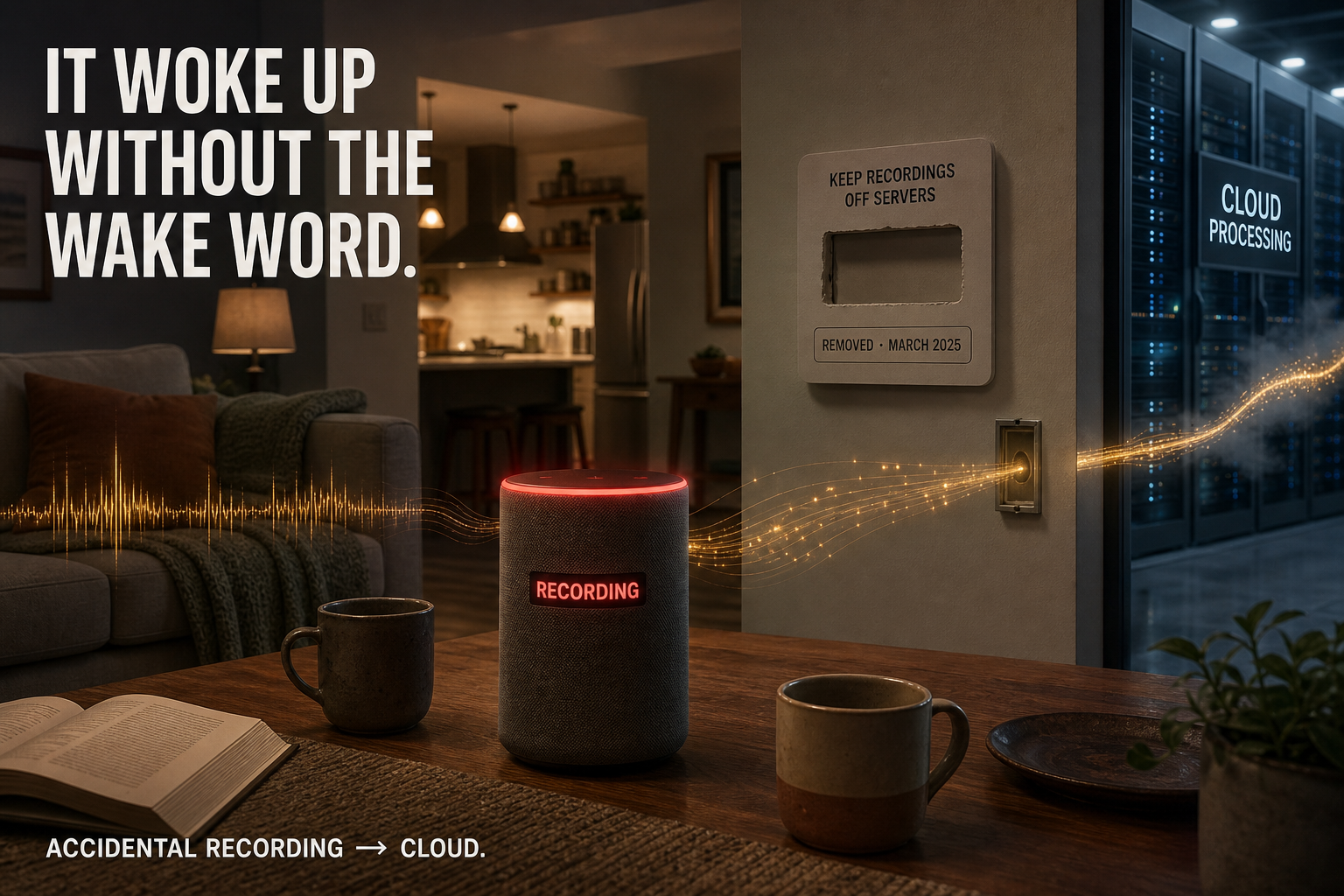
On March 28, 2025, Amazon emailed a small group of Echo owners — those with an Echo Dot 4th generation, Echo Show 10, or Echo Show 15, set to English in the US — to tell them a setting called "Do Not Send Voice Recordings" was going away. Amazon's own words: "As we continue to expand Alexa's capabilities with generative AI features that rely on the processing power of Amazon's secure cloud, we have decided to no longer support this feature." Fewer than 0.03 percent of customers had it turned on, per Amazon. It's worth being precise about what changed: every other Echo model already sent audio to Amazon's servers. What March 28 killed was the last option to keep voice data off the cloud entirely — and it was killed specifically to make room for Alexa+, Amazon's subscription generative-AI tier.
What's still true: Amazon lets you auto-delete recordings after three months or 18 months, or choose not to save them at all. But choosing not to save recordings deletes your Voice ID, and Voice ID underpins the personalization Alexa+ is built around — so the privacy-protective choice comes with a cost to the product. And joining Alexa+ automatically turns on "Follow Up Mode" on compatible devices, which lets Alexa keep listening for a follow-up request without you saying the wake word again.
The part nobody can fully control: it's already listening by accident
A peer-reviewed study out of Northeastern University and Imperial College London — researchers played 134 hours of Netflix dialogue at seven different smart speakers and measured what woke them up — found accidental activations happen at a rate of roughly 1.43 times per 10,000 words spoken nearby. In 10 percent of those misactivations, the device kept listening for at least 10 seconds before stopping. The most important finding for anyone trying to reason about this isn't a single number — it's that how often a given false wake repeats is inconsistent and device-specific: on most devices the large majority of false wakes were one-off, not reproducible when researchers replayed the identical audio, though a meaningful minority — most pronounced on the Google Home Mini, where about one in five false wakes reliably recurred — were consistent. That inconsistency is the point: no company can honestly promise you it won't happen to you, and there's no way to audit for it in advance. A separate, independent research team in Germany found more than 1,000 ordinary phrases that will falsely wake a major assistant — including the word "unacceptable" for Alexa.
Humans have listened before, and still can
In 2019, reporting broke that all three major assistant makers had human contractors reviewing clips of what people said to their devices. Amazon's contractors, spread across the US, Costa Rica, Romania, and India, transcribed clips that included medical conversations, domestic disputes, and what one contractor described as what sounded like a sexual assault — carrying the user's account number, first name, and device serial. Apple's contractors, per a Guardian report the same year, regularly heard confidential medical details and sexual encounters, much of it triggered by accidental activations, not real requests. Google paused human review of its own recordings the same year after Belgian broadcaster VRT obtained over 1,000 leaked clips, including recordings from inside people's bedrooms.
All three companies changed their practices — but human review didn't stop, it became opt-in. Amazon's help page today states plainly that a "small sample" of interactions get human review as part of "supervised machine learning," unless you turn it off. Apple's policy states unless you opt in to "Improve Siri and Dictation," your audio isn't stored — but adds a line worth reading twice: Apple "may review a subset of the transcripts of your interactions with Siri" regardless, and that subset "may be kept beyond two years."
What it's cost the companies
Amazon paid $25 million in 2023 — without admitting or denying the FTC's allegations, standard for this kind of settlement — over charges that it kept children's Alexa voice recordings indefinitely, even after parents asked for deletion, and that roughly 30,000 employees could access those recordings. Apple agreed to a $95 million settlement on the same no-admission basis — final court approval came in October 2025, with payments landing in early 2026 labeled "Lopez Voice Assistant" — over claims that Siri recorded people after accidental activations and that those recordings were heard by contractors. Apple has additionally said, on the record, that it has "never used Siri data to build marketing profiles, never made it available for advertising, and never sold it to anyone for any purpose."
The evidence that mostly wasn't there
In a decade of smart speakers sitting in American living rooms, there are only three known criminal cases where police sought recordings as evidence — an Arkansas hot-tub death (the victim, Victor Collins, died Nov. 22, 2015), a New Hampshire double murder in 2017, and a Florida killing in 2019. Two of the three defendants were convicted: Timothy Verrill was found guilty of two counts of second-degree murder in April 2024 and sentenced to 45 years to life; Adam Crespo was convicted of second-degree murder in August 2025 and sentenced to life in prison that October. In neither case did the Echo recordings themselves supply the evidence that produced the verdict — other evidence did — but both men were convicted, and it would be wrong to read this section as saying otherwise. Only the Arkansas case ended without a conviction: prosecutors said the recordings contained no evidence at all and dropped the charge. Amazon initially fought that warrant on First Amendment grounds, arguing its recordings and responses were protected speech — but the defendant consented to release the recordings before a judge ever ruled on the argument, so nine years later, the constitutional question about whether police need special justification to get your Echo recordings has never actually been answered by a court.
And here's what's missing entirely: Amazon, Google, and Apple all publish periodic transparency reports listing government data requests, organized by legal-process type and jurisdiction. None of the three publicly breaks voice-assistant data out as its own category in those reports. There is no public number, anywhere, for how many times a government agency has specifically asked Alexa, Google Assistant, or Siri to hand over what you said to it.
What this piece is not saying
This isn't saying your Echo or Google Home is recording you constantly on purpose — the architecture is wake-word detection first, cloud processing after, and the accidental activations documented above are exactly that: accidents, not a hidden always-on stream. It isn't saying Apple, Google, or Amazon currently sell your voice recordings for advertising — no evidence supports that claim, and Apple has denied it directly and specifically. And it isn't claiming any of the three named criminal cases proved a smart speaker caught a murder on tape — none of them did.
What can I do
Amazon: Alexa app → More → Settings → Alexa Privacy → Manage Your Alexa Data → choose auto-delete at 3 or 18 months, or "Don't save recordings" (know that this disables Voice ID). Turn off human review under the same privacy menu. If you join Alexa+, check whether Follow Up Mode got turned on and switch it off if you don't want the mic listening for a second request without the wake word. Every Echo has a physical mic mute button that Amazon says disconnects microphone power — use it when you want a hard off.
Google: Voice & Audio Activity is off by default — leave it off if you want audio never recorded. If you use Gemini for Home (rolling out since October 2025), know that Google's own help pages do not yet state a retention period or human-review policy for audio processed through it — that's an open question worth asking Google directly.
Apple: Settings → Siri → Siri & Dictation History → delete history. Settings → Privacy & Security → Analytics & Improvements → turn off "Improve Siri & Dictation" to opt out of the program that allows transcript review. One real limitation: unlike Echo and Nest, there is no hardware microphone switch on iPhone, iPad, or HomePod.
Why this is a BL:UF story
The 2019 scandal made people think the fix was "stop letting humans listen." The fix was actually "make listening opt-in" — which means it's still happening, just with a checkbox most people never find. Meanwhile the device got better at listening by accident, not worse, and the industry's own research proves that failure mode can't be predicted or eliminated. And after a decade, nobody — not the companies, not any regulator — can tell you how often the government has actually asked for what your house heard.
The Receipts
- TechCrunch: "Amazon's Echo will send all voice recordings to the cloud starting March 28," March 15, 2025
- Dubois, Kolcun, Mandalari, Paracha, Choffnes, Haddadi: "When Speakers Are All Ears," Proceedings on Privacy Enhancing Technologies 2020, Issue 4 — the peer-reviewed source for the 1.43-per-10,000-words and 10-second/repeatability figures
- Schönherr, Golla, Eisenhofer, Wiele, Kolossa, Holz: "'Unacceptable, where is my privacy?' Exploring Accidental Triggers of Smart Speakers," arXiv:2008.00508 — the German false-trigger-phrase study
- Bloomberg via CNBC: "Amazon Workers Are Listening to What You Tell Alexa," April 10, 2019
- The Guardian: Apple contractors regularly hear confidential details via Siri, July 26, 2019
- VRT NWS: Google Assistant recordings leaked, including from inside people's homes, July 2019
- Apple Newsroom: "Improving Siri's Privacy Protections," August 28, 2019
- FTC press release: U.S. v. Amazon.com (Alexa), $25 million COPPA settlement, May 31, 2023
- Courthouse News: "Judge approves $95 million Apple settlement over Siri privacy case," October 2025
- Amazon: "Alexa, Echo Devices, and Your Privacy" — current help page
- Amazon Information Request Report, H1 2025, published July 31, 2025
- Apple, "Ask Siri, Dictation & Privacy" — current policy
- Court TV: Timothy Verrill sentenced to 45 years to life, May 2024
- CBS Miami: Adam Crespo convicted of second-degree murder, sentenced to life, October 31, 2025
Full sourcing detail, including everything flagged single-sourced or needing further verification, is in newsroom/research-surveillance-sweep-2026-08-24.md.