The mountain everyone pictures is now a ticketed hike
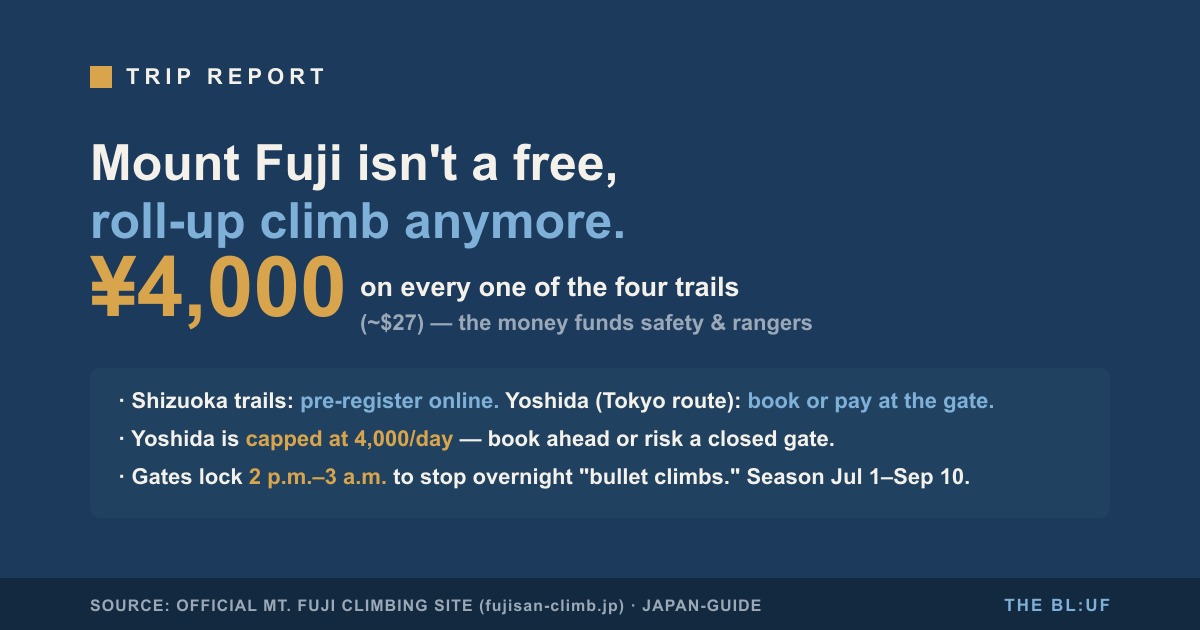
Mount Fuji looks like the ultimate spontaneous bucket-list climb: a perfect cone, a well-worn path, a sunrise from the summit. That picture is out of date. As of the 2026 season, climbing Japan's most famous peak works more like a timed-entry attraction than a free trail. Every climber on all four official routes — Yoshida, Subashiri, Gotemba, and Fujinomiya — pays ¥4,000 per person.
How you pay depends on the side. On the three Shizuoka-side trails (Subashiri, Gotemba, Fujinomiya) you must register and pay online in advance and complete a short safety briefing before you go. On the Yoshida Trail — run by Yamanashi Prefecture — you can either book ahead or pay at the gate on the day; but booking is the only way to guarantee you get through, because Yoshida turns climbers away once it hits its daily limit.
This is the first season the fee is the same across the whole mountain. It didn't start that way.
Why the rules exist
Fuji has been loved close to death. Roughly 220,000 people climb it each summer, and it's been a UNESCO World Heritage Site since 2013. In recent years the trails were choked with crowds and litter, and rangers kept seeing people in sneakers and shorts, and "bullet climbing" — hiking through the night with no rest to catch the sunrise, then needing rescue when the cold and altitude hit.
In 2024, Yamanashi Prefecture responded on the Yoshida Trail alone: a physical gate, a ¥2,000 charge, and a 4,000-per-day limit. In 2026 the whole mountain adopts the ¥4,000 fee, and the money funds safety staff, ranger patrols, and multilingual help for foreign climbers. It is a deliberate overtourism response, not a cash grab.
What this changes for your trip
The gate hours are the trap most travelers miss. On all four trails, entry is closed from 2 p.m. to 3 a.m. the following morning — unless you hold a mountain-hut reservation, which lets you pass. The classic budget move — climb overnight and skip paying for a hut — no longer works without that hut booking. Otherwise you climb during the day and time your summit push from the huts.
The Yoshida Trail, reached easily from Tokyo, is the one that can sell out: it's capped at 4,000 climbers a day, and once the quota fills, the gate closes. Book early, or start from the quieter Shizuoka side, which uses a separate registration system and — as of 2026 — has not announced a hard daily cap.
Two systems, not one: the Yoshida Trail books through Yamanashi's site; the other three go through Shizuoka's registration. Don't assume one booking covers the mountain.
Gear is taken seriously, too. The trails expect proper footwear, cold-weather clothing, and rain gear, and staff can stop climbers who show up without it. The summit sits above 12,000 feet and can be near freezing even in July.
The bottom line
Fuji is still open to ordinary hikers, and ¥4,000 is not a lot. But it is no longer a decision you make on a whim at the trailhead. The season runs July 1 to September 10 (the Fujinomiya and Gotemba trails open July 10). Pick your trail, sort your booking — pre-register for the Shizuoka trails, and reserve Yoshida ahead if you want to beat its cap — pack real gear, and climb.
The Receipts
BL:UF doesn't ask you to trust us. Check our work:
- ¥4,000 fee, Yoshida 4,000/day cap, gate 2 p.m.–3 a.m., season July 1–Sept 10, required gear — Official Mt. Fuji Climbing site, Yamanashi (Yoshida)
- All four trails ¥4,000; Shizuoka trails require online pre-registration + safety briefing; no Shizuoka daily cap; trail-by-trail dates — japan-guide.com, "Climbing Mount Fuji" (2026)
- 2024 Yoshida ¥2,000 fee + gate + 4,000/day cap origin; overtourism context — Time; Nippon.com
- ~220,000 climbers/season; UNESCO site since 2013 — Green Network Asia