What actually changed
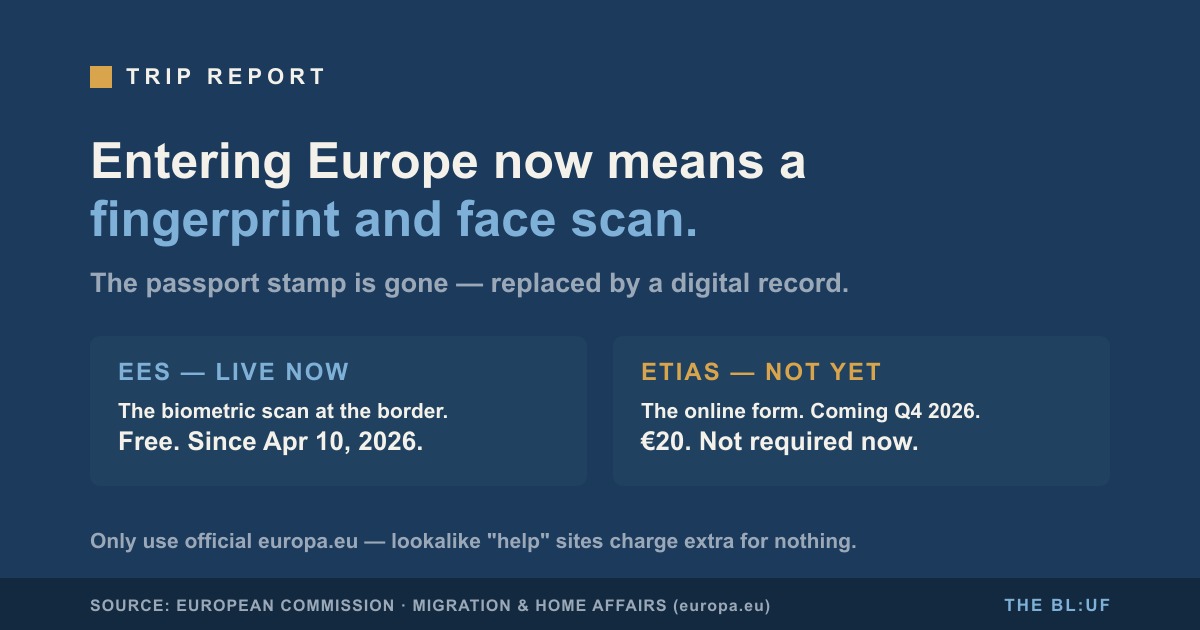
For decades, entering the Schengen area meant a quick passport stamp. That is over. Since April 10, 2026, the Entry/Exit System (EES) is fully operational at all external border crossings of the 29 countries that use it. Instead of a stamp, the border records your passport details, your facial image, your fingerprints, and the date and place of every entry and exit. The system is built to catch people who overstay and to fight document and identity fraud.
The rollout was gradual. The EES first went live on October 12, 2025, at a limited number of crossings, then expanded until it reached full coverage on April 10, 2026. So the "will this be running when I land" question is settled: yes, everywhere, now.
Who this hits
The EES applies to all non-EU nationals traveling for a short stay — meaning US, Canadian, UK, Australian, and other non-EU visitors. "Short stay" has a precise legal meaning: up to 90 days within any 180-day period, counted across all the participating countries together, not per country. The EES is the tool that now tracks those days automatically, so casual overstaying is far easier for authorities to spot.
What a traveler does at the border
The first time you enter after the system started, you register: passport scanned, four fingerprints taken, and a photo captured. That first registration takes longer than an old-style stamp, so build in extra time at passport control — especially at busy airports in the early months. On later trips, the border reuses your record and mostly re-checks your face or fingerprints, which is quicker. The EES record is kept and reused for three years.
Two practical notes. First, the EES itself costs nothing — there is no fee to be scanned or registered. Any site asking you to "pay for EES" is not official. Second, this is a border-control system, not an application you fill out in advance; there is nothing to do before you fly except expect the scan.
The thing that is coming next: ETIAS
Do not confuse the EES with ETIAS. ETIAS (European Travel Information and Authorisation System) is a separate, pre-trip online authorization for visa-free nationals — roughly 60 countries, including the US. It is not required yet. The EU has confirmed ETIAS will start operations in the last quarter of 2026, and the fee is set at €20 (raised from the originally planned €7). An approved ETIAS is valid for up to three years or until your passport expires, whichever comes first. Travelers under 18 or over 70 are exempt from the fee but still have to apply.
Bottom line for a summer 2026 trip
Flying to Europe now: expect the fingerprint-and-face scan at the border, allow extra time on your first post-April entry, and know your 90-in-180 days are being counted digitally. You do not need ETIAS for a trip taken before it launches in late 2026 — but if you travel again after it goes live, plan to apply and pay the €20 before you go. Only ever use official europa.eu sites; the EES and ETIAS are both government-run, and lookalike "help" sites charge extra for nothing.
The Receipts
BL:UF doesn't ask you to trust us. Check our work:
- EES fully operational as of April 10, 2026 — European Commission, Migration and Home Affairs
- What EES records; how it works — EU EES policy page
- EES vs ETIAS — the differences (EES free; 90/180 rule; ETIAS is separate) — European Commission
- ETIAS €20 fee, launching Q4 2026 — European Commission