What is known
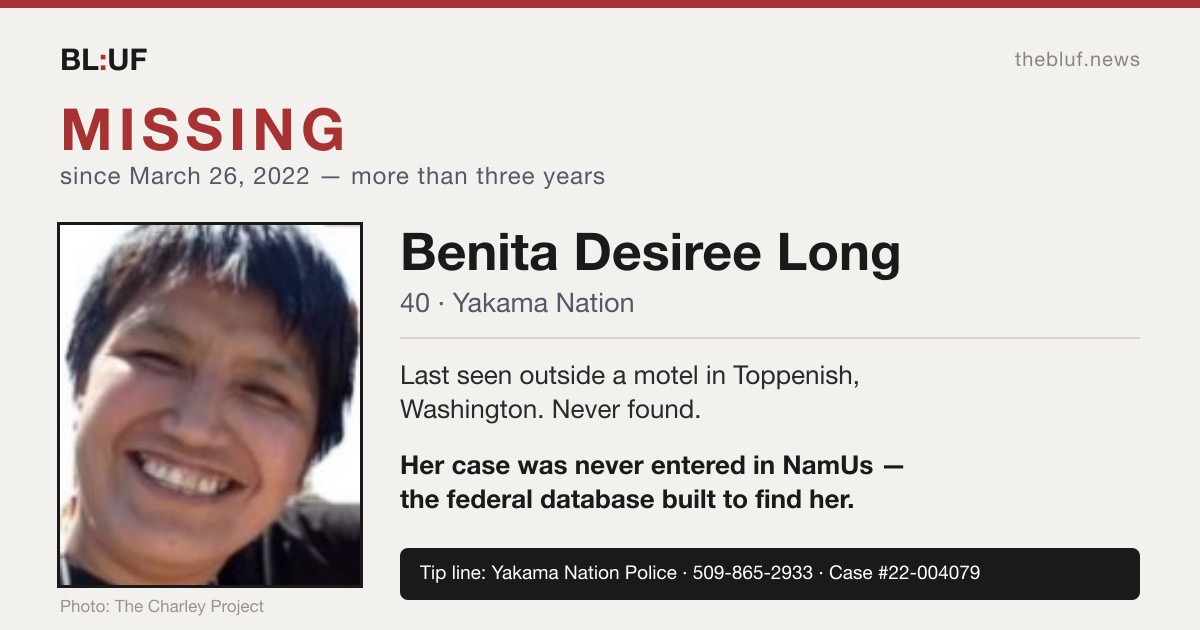
Benita Long was 40 when she was last seen on March 26, 2022, outside the El Corral Motel in Toppenish, Washington, near the Yakama Nation reservation, in gray sweatpants and a black hoodie. Her family reported her missing to the Yakama Nation police. She has not been found. Those facts come from an NPR investigation published March 10, 2025, by reporters Jaclyn Diaz and Nick McMillan.
Her family speaks of her in the present tense. "She showed me how to stick up for myself, kind of be strong," her cousin Loni Long told NPR. "We need the help. She needs the help."
What is also known is what her case is not part of. NamUs — the National Missing and Unidentified Persons System — is the federal database designed to match missing-person reports against unidentified remains found across the country. Benita Long's name is not in it. Of 127 Indigenous people listed as missing in Washington State Patrol data as of early January 2025, only 55 appeared in NamUs — leaving 72 people, Benita among them, outside the one national system meant to find them.
Why a name goes missing from the database
Entering an adult into NamUs is, in most of the country, voluntary. The federal NamUs program says just 17 states have passed laws mandating its use, and Washington is not one that requires local police to comply. "NamUs does not have all the missing or unidentified or unclaimed persons cases that exist in the United States," the system's program manager, Chuck Heurich, told NPR. Abigail Echo-Hawk of the Urban Indian Health Institute has called for national legislation requiring NamUs use everywhere. The scale of what the gap can hide is documented: the FBI's National Crime Information Center reported 5,712 missing American Indian and Alaska Native women and girls in 2016; NamUs logged 116.
What is claimed, and by whom
Benita's aunt, Georgette Long Abrahamson, told NPR that when the family reported Benita missing, police "didn't really take it serious." That is the family's account of how the case was handled; the Yakama Nation police, the agency the family first turned to, did not respond to NPR's repeated inquiries, so their side is not on the record. We treat the characterization as the family's, not as an established finding.
What is unknown
Whether Benita Long is alive. What happened to her after that March night in Toppenish. Why, specifically, her case was never entered into NamUs. No remains have been identified as hers, and no one should read this as a death — she is a missing person, and her family is still looking.
The coverage math
A person's odds of becoming a national story are not evenly distributed. The Columbia Journalism Review's "Are You Pressworthy?" tool — built from a sample of missing-persons news stories weighted by age, race, gender, and location — was designed to show exactly that. Run for someone like Benita — a middle-aged Indigenous woman in a rural county — the model lands near the very bottom of its scale, far below what it predicts for a young white woman in a city. The point isn't the precise figure. It's that the same forces that keep a name out of the news are the ones that keep it out of the database.
What could actually change this — the system, not the case
The hole is fixable, and the fix is legislative, not personal. Seventeen states already require law enforcement to enter missing-person cases into NamUs; most, including Washington, don't. Savanna's Act (2020) pushed the Justice Department toward better data-sharing on missing and murdered Indigenous people and NamUs outreach, but stopped short of a national entry mandate. A reader who wants to do something does it upstream — asking whether their own state requires NamUs entry for missing adults, and pressing for it where it doesn't — not by treating one family's tragedy as a case file.
If you or someone you know is in crisis, call or text 988 for the Suicide & Crisis Lifeline. Anyone with information about Benita Long can contact the Yakama Nation Police Department at 509-865-2933 (case #22-004079); missing-person and unidentified-remains cases can also be submitted at NamUs.gov.