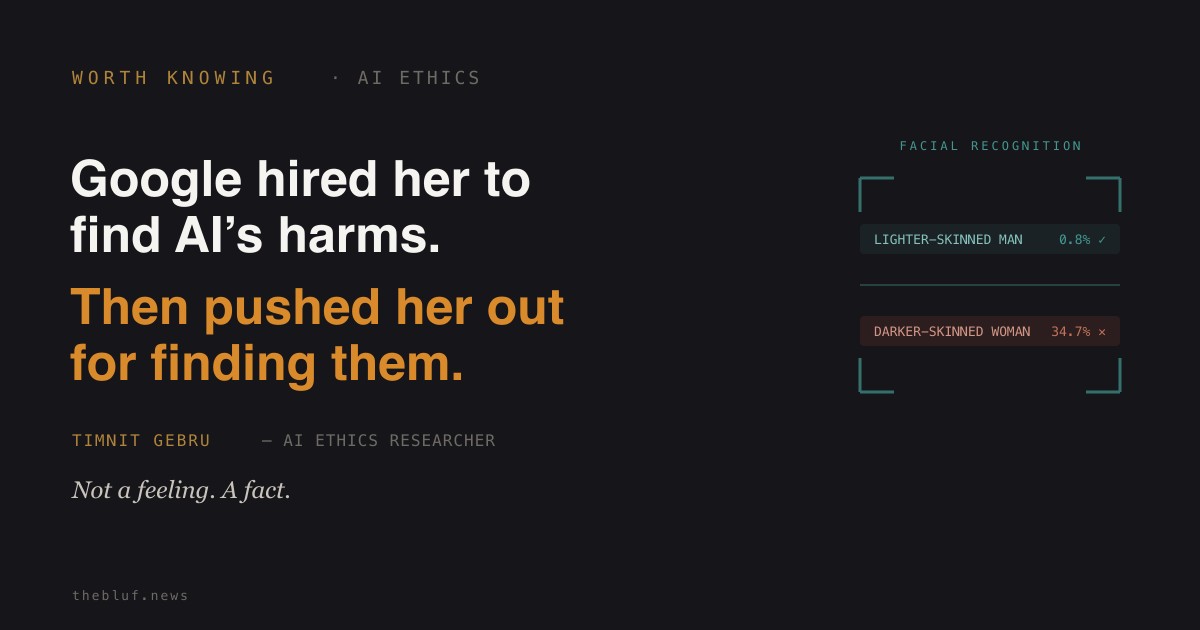
Timnit Gebru is the computer scientist who turned “AI is biased” from a worry into a measurement — and then lost her job at Google for warning that the next generation of AI carried the same flaw at a far larger scale. In 2018 she co-authored a study proving that commercial facial-recognition systems misread darker-skinned women far more often than lighter-skinned men: an error rate under 1% for the best-served group, and 34.7% for the worst. In 2020, after she co-wrote a paper raising the same alarm about the large language models behind today's chatbots, her career at Google ended in a public rupture. She says she was fired; Google says she resigned. She built her own institute and kept measuring. The numbers haven't changed.
From a war to Stanford
Gebru was raised in Addis Ababa. Her father, an electrical engineer with a PhD, died when she was five; her mother, an economist, raised her and her sisters. Both parents were from Eritrea — which is why, when Gebru was fifteen, the Eritrean–Ethiopian War put the family in danger. Some relatives were deported to Eritrea and forced to fight. She fled.
The path out was not clean. She was denied a U.S. visa and spent time in Ireland before being granted political asylum — an experience she later summed up in one word: "miserable." She landed in Somerville, Massachusetts, and enrolled in high school, where, by her account, teachers tried to keep her out of Advanced Placement classes she was already outscoring. She got in anyway.
In 2001 she enrolled at Stanford and stayed through a PhD in electrical engineering and computer vision, advised by Fei-Fei Li, one of the field's most prominent researchers. She worked at Apple on signal-processing for the first iPad. At the field’s marquee AI conference she counted the room — thousands of researchers, almost none of them Black — and in 2017 co-founded Black in AI with fellow researcher Rediet Abebe, now a network of thousands across dozens of countries.
The study that stopped the industry cold
In 2018, with researcher Joy Buolamwini, Gebru published Gender Shades — a test of the facial-recognition systems that companies were already selling to police departments and governments.
The results weren't opinions. They were measurements. On systems from IBM, Microsoft, and Face++, the error rate for lighter-skinned men was under 1%. For darker-skinned women it was 34.7%. For the women with the darkest skin tones, two of the systems were wrong 46.5% and 46.8% of the time — barely better than a coin flip.
The industry moved fast. IBM revised its system within a day of publication; Microsoft announced changes. (Amazon's Rekognition faced the same scrutiny a year later, after a 2019 follow-up study.) For the first time, algorithmic bias wasn't a future worry — it was a documented harm, already shipped, with a number attached.
The paper Google didn't want
In 2018 Google had hired Gebru as technical co-lead of its Ethical AI team — to find problems before they caused harm. In 2020 she and several colleagues drafted a paper, "On the Dangers of Stochastic Parrots," asking whether AI language models could be too big. It raised three warnings: that models trained on the open internet absorb and repeat its biases at scale; that training them carries a heavy environmental cost; and that the datasets are too large for anyone to fully audit. The paper didn't ask AI to stop. It asked the industry to slow down.
Google asked her to withdraw it, or to remove its Google authors' names. She asked, in return, for an account of who had reviewed the paper and how. On December 2, 2020, her employment ended.
Here the two sides part. Gebru says she was fired; an email from a manager told her reports the company had accepted her resignation — which she says she never offered. Google's AI chief, Jeff Dean, told staff the paper "didn't meet our bar for publication" because it "ignored too much relevant recent research." In the weeks that followed, roughly 2,700 Google employees and more than 4,300 academics and civil-society figures signed a letter condemning the exit; nine members of Congress wrote asking Google to explain. CEO Sundar Pichai apologized to staff and ordered a review of what happened.
What she built
One year to the day after the exit — December 2, 2021 — Gebru launched DAIR, the Distributed Artificial Intelligence Research Institute: foundation-funded, with researchers across several continents, accountable to no shareholder and no earnings call. The work Google had hired her to do, she set up to do on her own terms.
The recognition followed: Time's 100 Most Influential People, Nature's ten people who shaped the year, Fortune's list of the world's greatest leaders, a place among the BBC's 100 Women.
Why it still matters
AI systems now help decide who gets a job interview, who gets approved for a loan, who gets flagged by a camera. They learn from historical data, and historical data carries historical bias — which the systems repeat, automatically, at a scale no person reviews in full. Gebru's career is one stubborn argument: that this can be checked, and should be, before the harm ships rather than after.
Less than 1% for lighter-skinned men. 34.7% for darker-skinned women. Those aren't feelings. They're facts — and they're still true.
Sources: Buolamwini & Gebru, "Gender Shades" (2018) and MIT News (Feb 2018) for the error-rate figures; MIT Technology Review and Google's own statements (Jeff Dean; Sundar Pichai) on the December 2020 departure; reporting on DAIR's December 2021 launch. Personal details (the AP classes, the asylum) are as Gebru has recounted them.