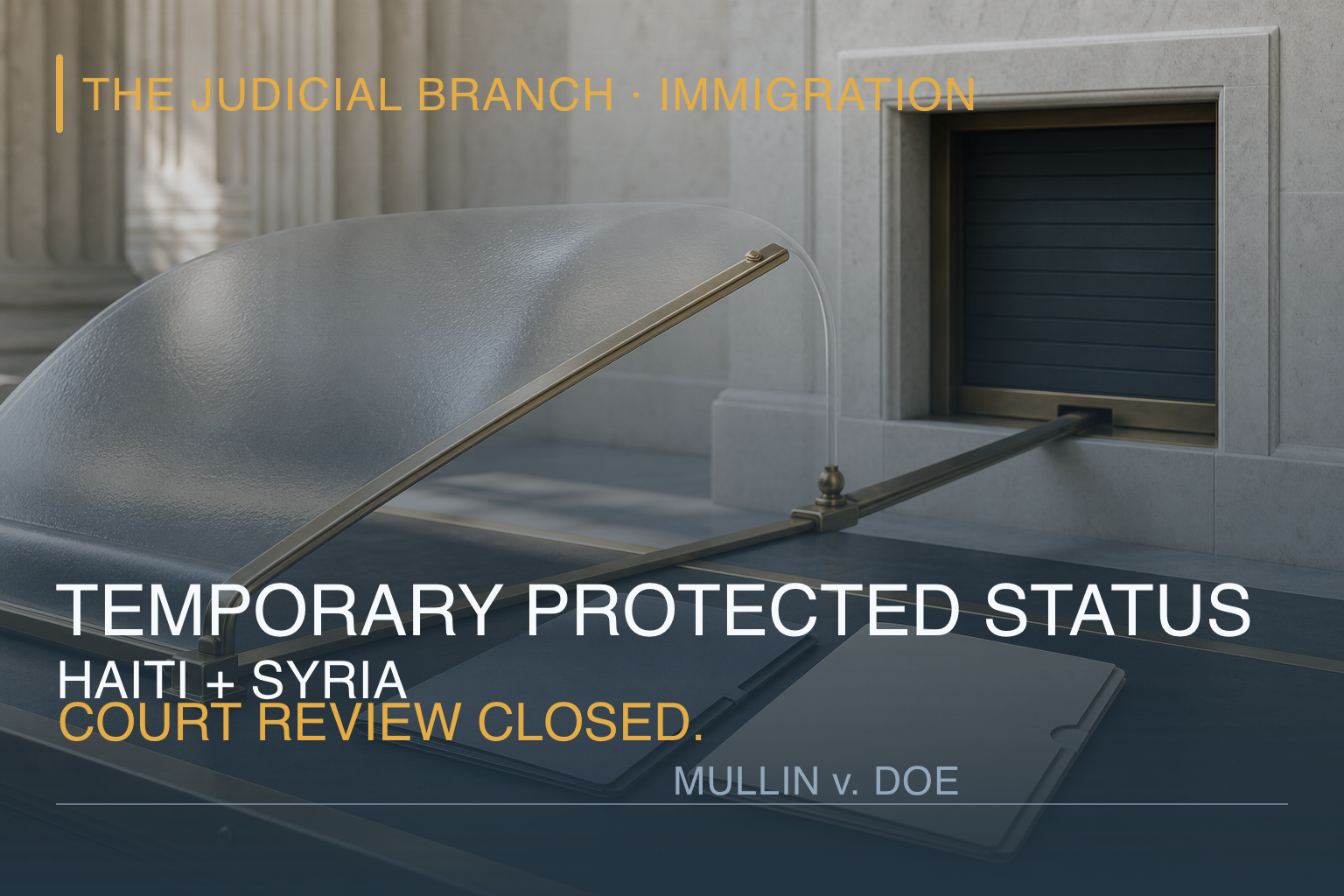
On June 25, 2026, the Supreme Court ruled 6–3 in Mullin v. Doe that courts cannot review the administration's decision to end Temporary Protected Status (TPS) for roughly 350,000 Haitians and 6,000 Syrians. Read the headlines and you'd think the Court ordered a mass deportation. It didn't. What it did is narrower, and in some ways more consequential: it took the courts out of the picture.
The Court did not order anyone deported, and did not rule that ending these protections was legal. It removed the legal check that had been holding the terminations up.
What the case was about
Temporary Protected Status is a program Congress created in 1990. It lets people from countries hit by war or disaster live and work legally in the United States while their home country is too dangerous to return to. Haiti and Syria are both designated.
The administration moved to end TPS for both countries. Lower courts paused that, finding the administration had likely skipped steps the law requires before a termination. The case reached the Supreme Court on whether those pauses should stand.
What the Court actually held
The TPS law contains a line saying there is "no judicial review of any determination" about a TPS designation. Writing for the majority, Justice Alito read that bar broadly: courts cannot hear ordinary (non-constitutional) challenges to the decision to end TPS. So the lower-court pauses were reversed, and the terminations can now take effect.
In plain terms: the question of whether the administration followed the rules is one a court is no longer allowed to answer.
What the ruling did NOT do
This is where most coverage overreaches. Be precise:
- It did not order anyone deported. It lifted court orders that had delayed the terminations. Actually removing someone still requires separate deportation proceedings, with their own rules.
- It did not rule that ending TPS for Haiti and Syria was lawful — only that courts can't review the question.
- It did not end the TPS program, and did not directly affect other countries' designations.
- It did not close the door on constitutional challenges. The claim that Haiti's termination was racially motivated wasn't thrown out for good — a four-justice plurality (not a majority) only said it was "unlikely to succeed" at this early stage, and that lawsuit continues. Justice Thomas, writing alone, would have gone further and barred constitutional claims too; the majority did not.
The dissenters — Justices Kagan, Sotomayor, and Jackson — argued the no-review bar covers only the final call about whether a country is safe, not whether the administration followed the mandatory steps Congress set before making it.
One number to be careful with: these cases covered about 350,000 Haitians and 6,000 Syrians. Larger figures you may see — "over a million" — come from immigrant-advocacy groups estimating everyone who could eventually be affected across all TPS countries. That is not a number the Court used, or a count of people it ordered removed.
What you can do
This is a ruling about a line Congress wrote into immigration law in 1990 — which means Congress can rewrite it. The cleanest fixes would be a bill restoring court review of TPS decisions, or one giving long-term TPS holders a permanent path to stay. Honestly, neither is moving right now.
The most advanced bill that touches this is H.R. 1689, which would require the government to designate Haiti for TPS — protecting Haitians specifically by writing the designation into law instead of leaving it to the administration. It passed the House 224–204 and is sitting on the Senate calendar without a vote. It doesn't fix the larger problem this ruling created — courts still couldn't review other TPS decisions — but it's the live lever for the community this ruling hits hardest. Read it in plain English on LegisPlain, or see the bill on Congress.gov. Here's how change actually happens after a ruling like this.