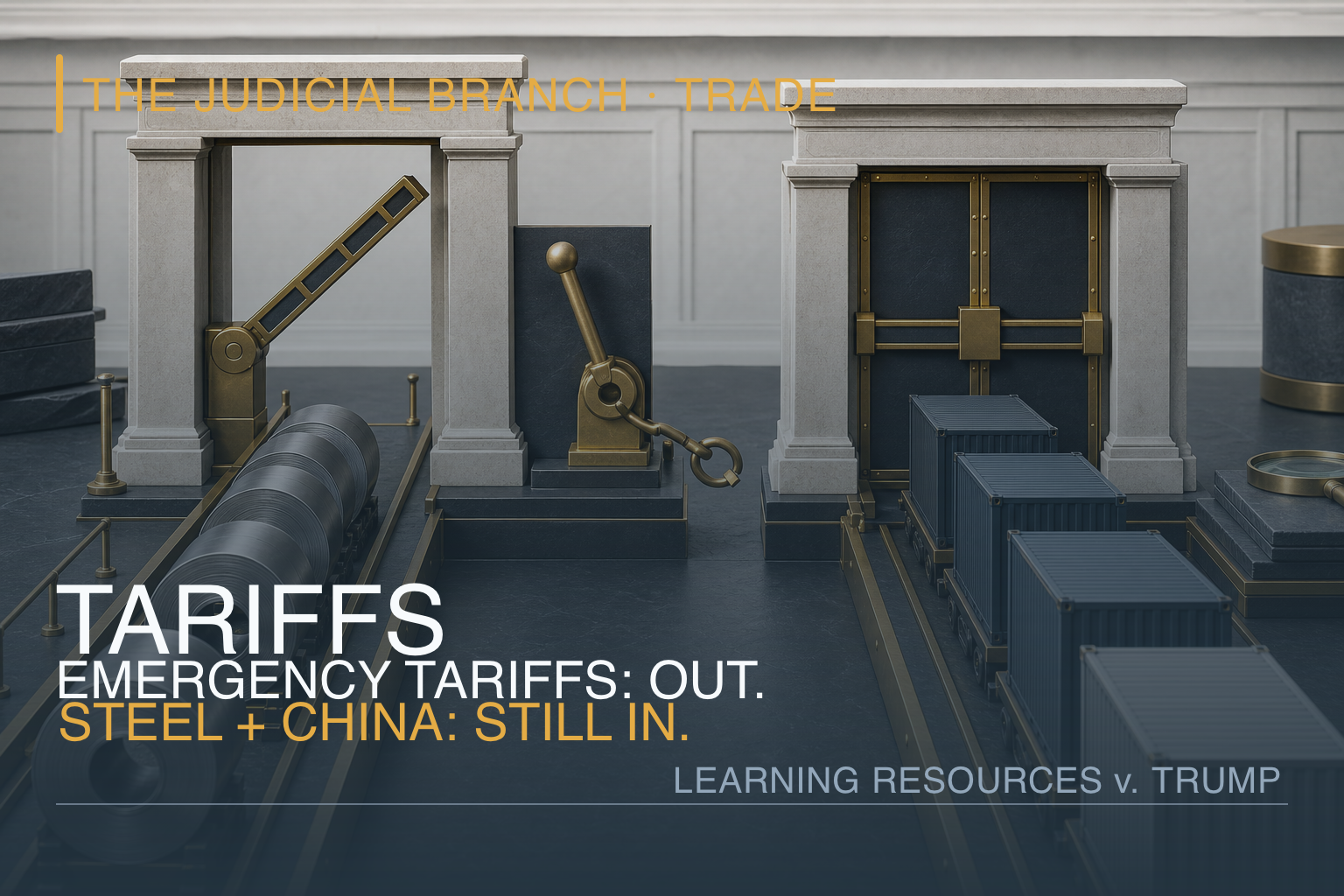
On February 20, 2026, the Supreme Court ruled 6–3 in Learning Resources v. Trump that the president cannot use a 1977 emergency-powers law to impose tariffs. That ended two big sets of tariffs: the across-the-board "reciprocal" tariffs announced on "Liberation Day" in April 2025, and the "trafficking" tariffs on Canada, Mexico, and China tied to fentanyl.
Here's the part most coverage will skip: the Court did not ban all tariffs. Tariffs imposed under other laws are still in force.
The lineup is part of the story
This was not the usual left–right split. Chief Justice John Roberts wrote the opinion, joined by the three liberal justices — Sotomayor, Kagan, and Jackson — plus conservatives Gorsuch and Barrett. The dissenters were Kavanaugh, Thomas, and Alito. Six justices from across the spectrum agreed the president had overstepped; three did not.
What the Court actually held
The law in question is IEEPA — the International Emergency Economic Powers Act — which lets a president respond to foreign threats by doing things like freezing assets and blocking transactions. The administration read its power to "regulate importation" as including the power to tax imports.
The Court said no. A tariff is a tax, and the Constitution hands the taxing power to Congress, not the president. "Regulate," six justices held, doesn't stretch to "tax" — and in IEEPA's 50-year history, no president had ever used it to impose a tariff until now.
One nuance worth getting right. Three justices — Roberts, Gorsuch, and Barrett — also leaned on the "major questions doctrine," the idea that a president needs clear permission from Congress before making decisions of enormous economic scale. But only those three signed onto that reasoning, so it is not the Court's holding. The binding ruling rests on the plain words of the law, which matters for how far the decision reaches.
What the ruling did NOT do
- It did not ban tariffs generally. The steel and aluminum tariffs (imposed under Section 232 of a 1962 trade law) and the China tariffs (Section 301 of a 1974 law) were not before the Court and remain in effect.
- It did not strip the president's other emergency powers — freezing assets, blocking transactions — which were never at issue.
- It did not undo the national emergency declarations themselves; only the tariffs built on them fell.
What you can do
The irony of this ruling is that it hands the question back to Congress — which held the tariff power all along. Congress can write a law that explicitly gives the president tariff authority (putting these tariffs back), or one that fences it in.
Two live bills point in opposite directions: the Trade Review Act of 2025 (S. 1272) would require the president to notify Congress within 48 hours of any new tariff and automatically end it after 60 days unless Congress votes to keep it — read it in plain English on LegisPlain or on Congress.gov; the Prevent Tariff Abuse Act (H.R. 407) would bar using IEEPA for tariffs at all, writing the Court's ruling into law. Here's how change actually happens after a ruling like this.