Here is what Oprah Winfrey actually said.
Accepting the LionHeart Award at Cannes Lions this month, she told a story from Whitney Houston's final appearance on her show. By Oprah's account, Houston "had gone back on drugs" and fell during the visit — and Oprah, knowing, as she put it, that "if that story got out that she'd fallen off the stage, she would be destroyed by that," begged the live audience not to release their photos. "They did not," she said. She'd kept it to herself for seventeen years.
So there are two things in that story at once, both true to her telling: a claim that a beloved icon — who can't respond — had relapsed, and an account of trying to shield her from the worst of it. People are furious about the first. It's worth holding the second.
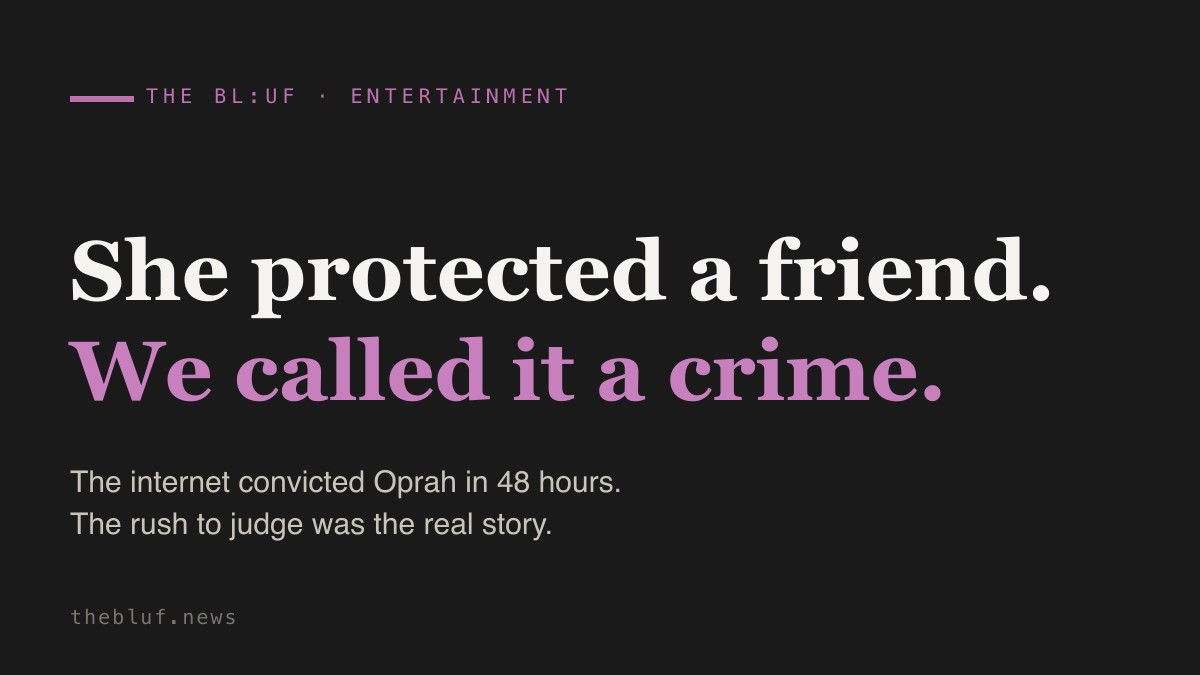
Within forty-eight hours, the internet had its verdict: Oprah was trashing Whitney's legacy. Why now? How tacky. The backlash was immediate and loud, bigger names lining up to swing. The judgment arrived fully formed — before Oprah had said a single word in response. She still hasn't.
Be careful here, because two very different responses got jammed together.
Whitney Houston's estate pushed back — and they were right to. Where Oprah described a fall during a performance, the family said it happened "during a sound check… due to the darkness of the area and her unfamiliarity with the stage," and that she "was absolutely not high." They added it is "inaccurate and unfair to attach that struggle to every performance or every chapter of her life." That is not a mob. That is a family protecting someone they love, with their own account, and they have every right to it. We weren't on that stage; neither were you. We're not going to tell you we know what happened, or call anyone a liar — Oprah was in the room and the family wasn't, but memory is not a courtroom transcript, and "fell" is a thing you see while "relapsed" is a thing you conclude. Two accounts can each be honest. The estate setting the record straight is fair. Honorable, even.
The other response — the rush to convict — is the part that should bother you.
Because look at what it did. It took a person with a forty-year record — a career built, across four decades and by most any measure, on lifting people up — and handed her the least benefit of the doubt at the exact moment her record had earned the most. The decent reflex, with someone you respect, is to ask before you accuse. The crowd inverted it.
Some of the loudest voices came from people with their own long-standing public disputes with Oprah — context worth knowing, not a verdict on anyone's motives. And there's a fair question in the noise, Mo'Nique's: "How do you speak about someone that can't defend it?" That's worth sitting with — it's the same instinct that makes the estate's correction fair. But you don't have to assume the worst of Oprah to ask it.
Here's where it leaves us. If one of the most beloved figures in American culture can be dog-piled in two days — before she's said a word — then the lesson was never really about Oprah. It's about the speed of the swing. Slow it down. Ask before you accuse. And give the people who've earned it the one thing the internet never wants to hand over: the benefit of the doubt.
🎧 Hear the full conversation on The Benefit of the Doubt — an episode of TLDR, the BL:UF podcast.
Receipts
- Oprah's Cannes account ("had gone back on drugs"; the "destroyed" quote; begging the live audience; the LionHeart Award) — The Hollywood Reporter, Variety
- The estate's response ("absolutely not high"; sound check / darkness; "every chapter of her life") — The Wrap, Variety
- Mo'Nique and Rickey Smiley's criticism; the documented Mo'Nique–Oprah history — The Shade Room, The Hollywood Reporter