When the Democratic Republic of Congo walked out for its first World Cup match in 52 years, something was missing — and the whole country noticed.
It wasn't a player. It was a fan. A man who, for the last decade, has done the same impossible thing at every match: climb onto a small pedestal beside the bench, raise his right arm to the sky, and then not move — not for a goal, not in the heat, not for the full ninety minutes. He doesn't cheer. He doesn't sit. He becomes a statue.
His name is Michel Kuka Mboladinga (some outlets render it "Nkuka"). Congo knows him as "Lumumba Vea" — "Lumumba Lives." Since 2013 he has been the most famous supporter his nation has, precisely because he refuses to behave like a supporter at all.
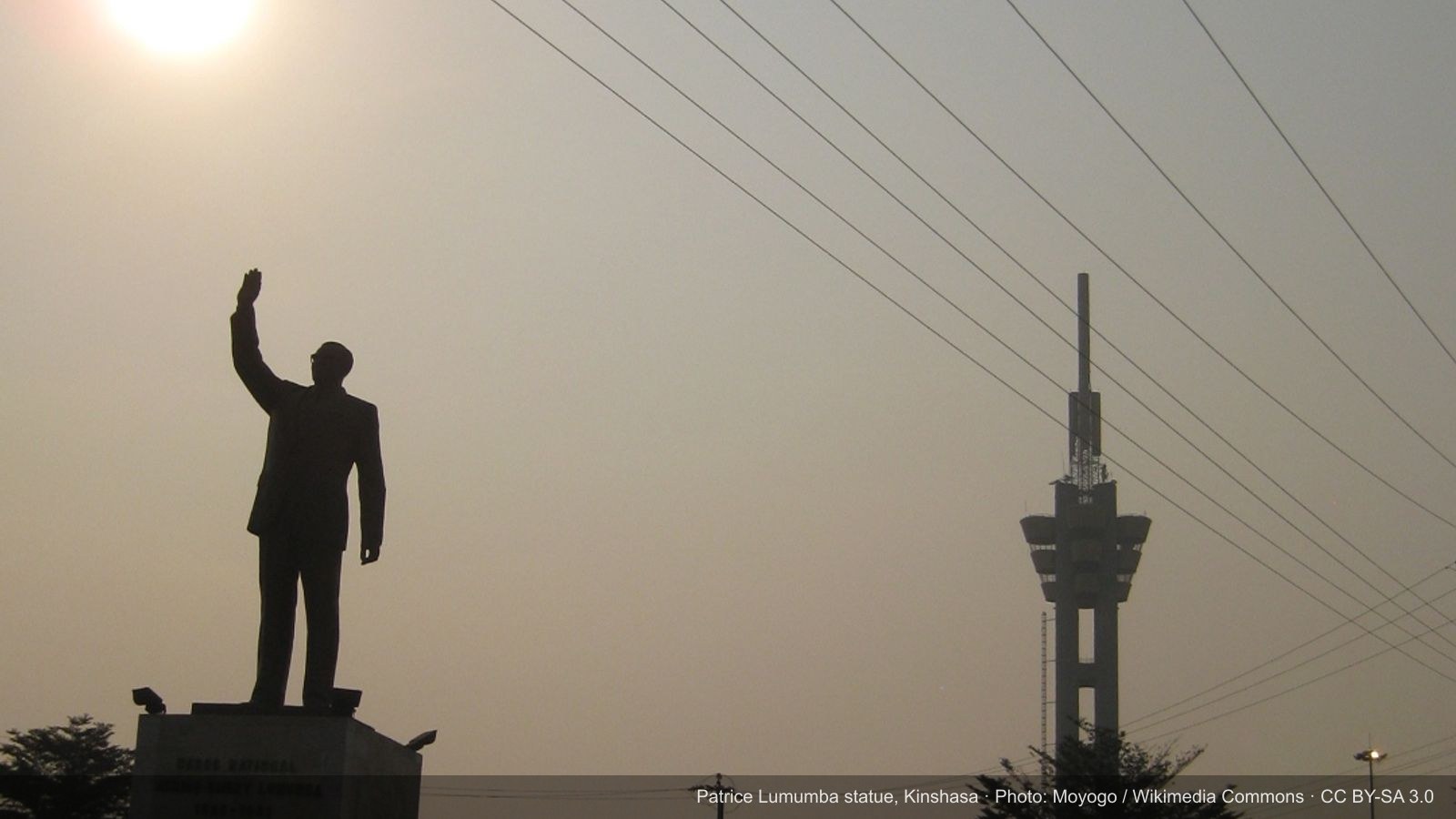
The pose is not a gimmick. It is an exact copy of the memorial statue of Patrice Lumumba that stands atop the Limete Tower mausoleum in Kinshasa, right arm raised — and Mboladinga happens to bear a striking resemblance to the man himself. To understand why someone will hold that position until his shoulder screams, you have to understand who Lumumba was, and what was done to him.
The man he becomes
Patrice Lumumba was Congo's first prime minister after it won independence from Belgium in June 1960. He held real power for less than three months. He has been revered for sixty-five years.
That gap — almost no time in office, a lifetime of reverence — is the whole story. Lumumba was the face of Congo's fight to be free of Belgian colonial rule, a rule that began when King Leopold II claimed the territory as his personal property in 1885 and ran it as one of the most brutal regimes in colonial history. On Independence Day, June 30, 1960 — sixty-six years ago to the day — Lumumba stood in front of the Belgian king and refused to be polite about it.
"No Congolese will ever forget that independence was won in struggle," he said. "Morning, noon and night, we were subjected to jeers, insults and blows because we were 'Negroes.' … We shall show the world what the Black man can do when working in liberty, and we shall make the Congo the pride of Africa."
Dr. Reuben Loffman, a historian of DR Congo at Queen Mary University of London, calls it "one of the most important speeches in the 20th century" — and the moment that marked Lumumba as a target. It was the Cold War, Loffman notes, and Washington was "particularly paranoid," sure he was a communist. "But of course, he wasn't. Lumumba just wanted Congo for Congolese."
It got him killed. Within three months he was removed from power by President Joseph Kasa-Vubu. Three months after that, forces loyal to Mobutu Sese Seko — who would go on to rule Congo for the next 32 years — captured him and flew him to the breakaway region of Katanga, where he was tortured and, with Belgian officers present, executed by firing squad on January 17, 1961. There was no trial. He was 35.
What happened to his body is the part people flinch at: thrown in a shallow grave, then dug up, dismembered, and dissolved in acid. The only piece of him that survived was a single gold-crowned tooth, kept for decades by the Belgian police officer who confessed to destroying the remains. It wasn't returned to Lumumba's family and buried until 2022 — in Kinshasa, beneath that statue with one arm raised.
That is the arm Mboladinga raises.
"I am a living statue"
Civil rights leader Malcolm X called Lumumba "the greatest Black man who ever walked the African continent" in 1964. Mboladinga puts it more simply. "He's my inspiration," he told CNN Sports from Mexico. "Patrice Lumumba is a symbol of unity — the one who taught Congolese to stand and to be proud."
So how does a person actually hold still, arm up, for an entire match, in foreign heat, in a suit?
"Believe it or not, but I do practice," he said. "I can actually practice 20 days out of a month, but I'll also take a lot of rest." The North American summer doesn't worry him. "I am a living statue. The climate has no impact on me. My job is not just to stand there, but rather to communicate energy, strength and power to the players. That is what I am focusing on. I do not foresee a time when I'm actually going to let go and lower my hand — I will get my job done."
The summer he almost didn't make it
He nearly missed all of it. An Ebola outbreak declared in DR Congo in mid-May — more than 1,000 people sickened, hundreds of deaths — led the United States to restrict entry from affected countries. It was serious enough that Congo's national team had to scrap its pre-tournament training camp in Kinshasa.
So the team refused to leave its most devoted fan behind. According to CNN Sports, the squad pushed the request all the way up to President Félix Tshisekedi, who agreed to fold Mboladinga into the official national delegation — the workaround that got him across the ocean. He missed the opener against Portugal in person, but followed it from a fan zone. "Although I was not there physically, I was able to attend the game at one of the fan zones, so I was very much connected," he said. "After going back to the World Cup after 52 years and then facing a giant like Portugal, to be able to draw with them was a great achievement — a joyful moment for the whole Congolese nation." Days later, in Mexico, he was finally there in the flesh, frozen on his pedestal as Congo played Colombia.
Then the tournament crossed into the United States — and a man who had just stood motionless for his country on two continents ran into the one thing he couldn't outlast.
The match he watched from the wrong side of a border
For Congo's decisive group-stage match against Uzbekistan in Atlanta, Mboladinga was denied a US visa. He did not make it. His team won 3-1 and advanced to the next round — their living statue nowhere in the stands.
Days earlier, before the denial, he had been certain. "I will be there," he'd said. "I will have a leopard print in the back. And the whole world will see me." It didn't happen.
What he's really standing for
Back home, what he represents matters more than any score. When DR Congo qualified, the celebration crossed even the front lines of the country's war in the east. "M23 rebels themselves here in Goma jubilated, and even in Kinshasa people also jubilated," journalist Prosper Heri Ngorora told CNN Sports from Goma. "That shows that football can be a glue that unites people together."
That is the thing Mboladinga keeps holding up, motionless, for 116 million people back home: not a team, but a memory the world tried to dissolve in acid and bury in an unmarked grave — and couldn't. A man can be kept out of a stadium by a stamp in a passport. The thing he's standing for is harder to stop.
He intends to keep his arm up.