You've seen the clip. A street in Tokyo's suburbs opens up and swallows a truck. A crater takes a police tow truck in Bangkok. A road drops out from under a motorcyclist in Seoul. The caption writes itself: the planet is opening up.
Here's what the investigation reports say instead, case by case.
The receipts from the last two years
Yashio, Japan (January 2025): a road collapsed under a truck driver, who died. Japan's expert committee spent a year on the cause and published it this February: a corroded sewer main, roughly 42 years old. Not geology — a pipe.
Bangkok (September 2025): the crater by the hospital — about 50 meters deep — formed when a subway tunnel joint under construction cracked after heavy rain and the soil flowed in. The governor said so directly.
Kuala Lumpur (August 2024): a tourist was swallowed on a sidewalk; the government told Parliament the trigger was a corroded sewer pipe that failed in unstable soil — and, pointedly, not the limestone many first blamed.
Godstone, England (February 2025): thirty homes evacuated. The British Geological Survey's read: most likely a burst water main flushed out the weak sands under the road.
St. Louis (June 2026): a sinkhole closed an interstate after three cascading water-main failures — one 20-inch main broke, washed out a sewer, and took two more mains with it.
Seoul (March 2025): a motorcyclist died when a road collapsed near metro-extension work; the government's final report, released in December 2025, found a combination of causes — years of falling groundwater, leaks from aging sewer pipes softening the soil, and an undetected weak zone above the subway-extension tunnel. Even the most complicated case on this list runs through pipes and digging. And Seoul's own numbers tell the wider story: 63 sinkholes in three years, and in South Korea's national count of 867 ground-subsidence incidents from 2020 to 2024, the single largest cause — 45% — was damaged sewer pipes.
Different countries, one pattern: when a city street collapses, the answer is almost always under the street, not under the Earth.
The boring math
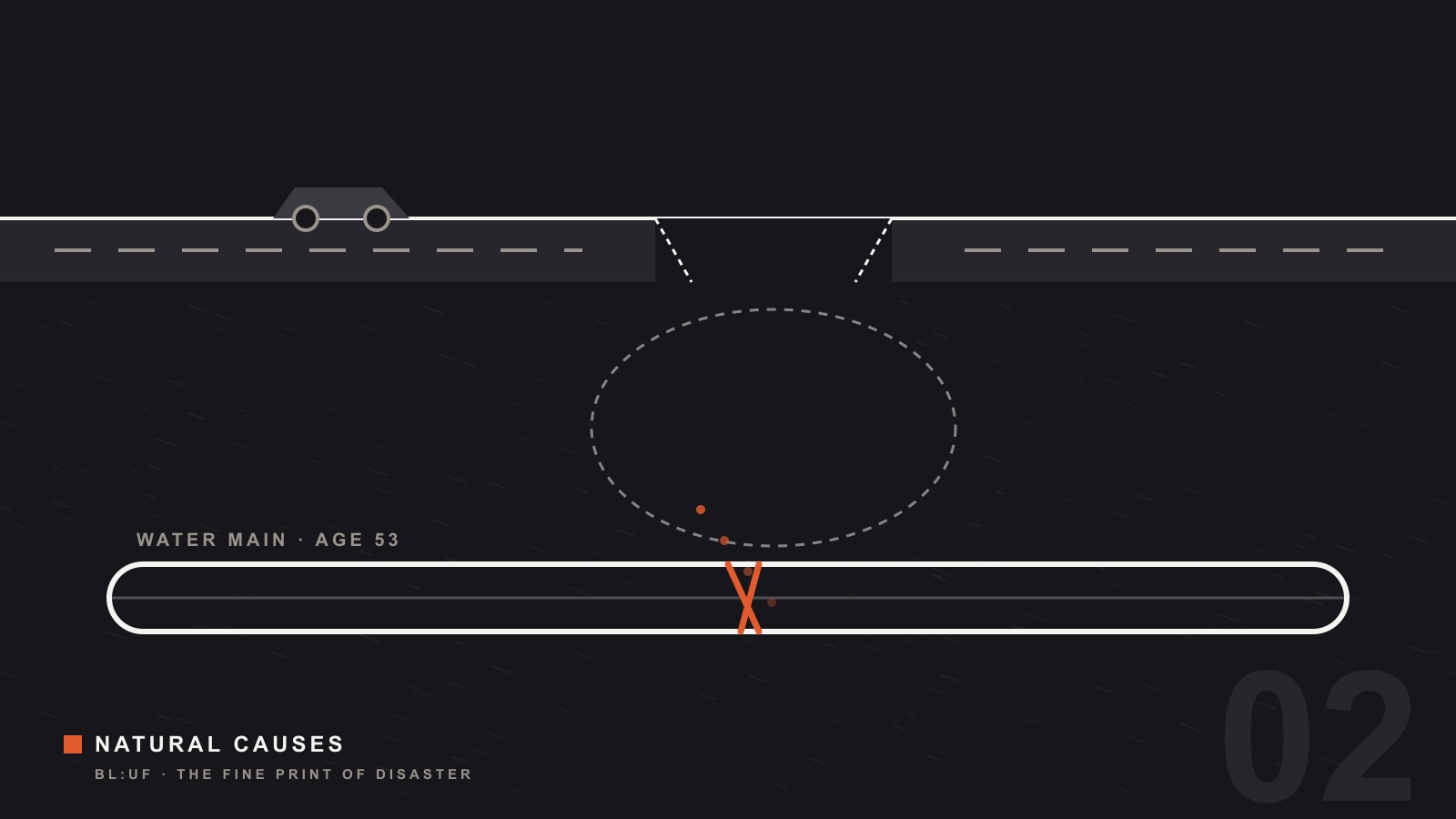
The United States and Canada break a water main about every two minutes — roughly 260,000 breaks a year, per a 2024 Utah State University study. The average age of a failing main: 53 years. Old cast-iron pipe fails at roughly ten times the rate of modern PVC. The American Society of Civil Engineers frames the replacement backlog as a $452 billion problem.
That's the monster under the road. It doesn't trend, because "city defers pipe replacement for 40 years" is not a thumbnail. The collapse is.
Even the famous monsters are mostly us
The giant holes in the viral compilations have investigation reports too. Guatemala City's perfectly round 2010 shaft — about 90 meters deep — formed in volcanic ash eaten away by leaking pipes, not limestone. Bayou Corne, Louisiana (which grew for years) was a collapsed industrial brine cavern. Berezniki, Russia — the one nicknamed "the Grandfather" — is a flooded potash mine. Daisetta, Texas sits on a salt dome drilled and injected by the oil industry for decades — the official cause was never settled, but every leading theory is industrial, not natural. The deep ones are nearly all mining, industry, or piping.
The honest caveat
Real, natural sinkholes exist — and Florida is built on them. Slightly acidic groundwater dissolves limestone over centuries; sometimes a roof lets go. Winter Park's famous 1981 sinkhole was genuine karst, and it's now a city lake. Even there, though, the trigger is often human: pumping groundwater removes the support holding a cavity's roof up. Nature digs the void slowly; we schedule the collapse.
So the one-question test when the next clip crosses your feed: is it a city street? If yes, the smart money is on a pipe, a tunnel, or a main — and the investigation report, when it lands months later and nobody covers it, will almost always say so.
The scary version asks whether the planet is waking up. The boring version is a 53-year-old cast-iron main, and the bill for replacing it.
The receipts
- Japan Times, Feb 2026 — Yashio committee finding (corroded ~42-year-old sewer).
- Bangkok governor via Khaosod English, Sept 2025; road reopening via Nation Thailand.
- SCMP / Korea Herald — Seoul collapse + subsidence data (63 in three years; 45% of 867 incidents sewer-linked); MOLIT Central Underground Accident Investigation Committee final report, Dec 2025.
- British Geological Survey via New Civil Engineer — Godstone water main; Surrey County Council updates.
- St. Louis American — the cascading main failures.
- Utah State University water-main break study (2024); ASCE on the $452B backlog.
- USGS Water Science School — how natural karst sinkholes form.