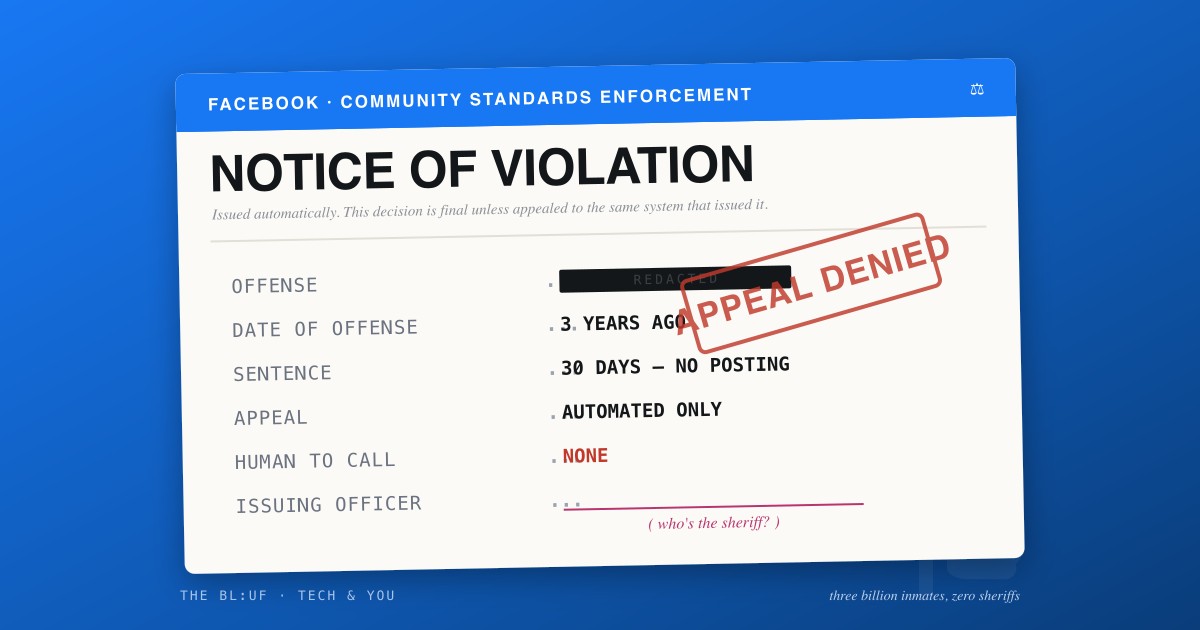
We all know the Facebook police. We've all done a stretch in Facebook jail.
You know the drill. First the warnings. Then the sentences: three days, seven days, thirty days where you can't post, can't comment, sometimes can't even log in like normal — over something you wrote years ago that an automated system just got around to flagging. You're rarely told exactly which rule you broke, or how, or by whom. You just get the cell.
Here's my favorite part. One of the things I got jailed for was something I'd gotten from Facebook — content the platform served into my own feed, that I shared, that the same platform later decided was a crime. I appealed that one. Of course I did.
And that's the question nobody can answer: who's the sheriff? We all know there's a police force. Nobody has ever met the officer, stood before the judge, or found the building where any of this is decided.
The faceless force
The honest version, first — because fair beats easy. At Facebook's scale, no company could put a human eye on every post. Meta removes or actions millions of pieces of content each reporting period, and for most categories the majority is flagged by Meta's own automated systems before any user ever reports it — what the company calls its "proactive rate." You cannot hire your way out of three billion users. Automation isn't a conspiracy; it's arithmetic.
But arithmetic explains the system. It doesn't excuse the experience — and the experience is opaque, retroactive, and wildly inconsistent.
Watch how inconsistent. Type the word gun and you might get flagged; type g_n, or pew pew, and you sail right through. The whole internet now speaks in this code — unalive, seggs, le$bian, corn — a workaround language invented specifically to dodge filters that catch the spelling but miss the meaning. A song plays fine in the U.S. and is dead silent for someone in Croatia, because of a licensing map you never see. A video gets its audio muted because an automated copyright system — like YouTube's Content ID — decided the soundtrack "isn't allowed," except the soundtrack is the person's own voice, flagged by a machine with no human in the loop — and somehow not every video, just that one. The rule isn't a rule. It's a slot machine.
And when the machine is wrong, here's your recourse: a button. You appeal into the same system that just convicted you, and you wait. Meta built an Oversight Board to hear appeals — a real thing, with real independence — but it decides only a few dozen cases a year (53 in 2023) against the roughly 400,000 appeals users sent it that year (Oversight Board, 2023). For everybody else, the appeal is another automated decision. There is no number to call. There is no person.
You serve billions. Find me one human.
This is the part that gets me. Facebook serves billions of people — McDonald's numbers — and for the ordinary user it offers no human being to talk to. No number to call. No person assigned to your case.
And the one exception proves the rule. Meta now sells "Meta Verified" for about $12 a month, which advertises access to a real person for account problems — and the documented record is that even paying customers routinely still can't get a serious one solved. Free users get a button and a bot. The richest, most sophisticated communications company ever built decided that a real conversation with you costs too much.
I know that's a choice and not a law of physics, because I've seen a company the same size make the other one.
What accountability actually looks like
About twelve years ago I was deployed to a military installation so new the systems hadn't caught up to it. We had an address. Mail was arriving — from everywhere except Amazon, whose system didn't recognize our ZIP code and refused to ship to it.
I told a coworker I'd get it turned on. He didn't believe me. So we bet a hundred dollars.
I started the responsible way, through the Postal Service — and had a better chance of hitting the Powerball than of navigating that bureaucracy. So after a few days I thought: what the hell — I'll email Jeff Bezos. This was the era of the famous public address that landed straight in the CEO's orbit — and the well-documented legend, which Bezos has confirmed himself, that he forwarded customer complaints to his executives with a single character, "?", and heads moved.
I sent the first email on November 14th. Nothing. The day before Thanksgiving, I followed up and asked for a status. I got a reply the next day. A few exchanges later, on December 20th, a real person on Amazon's executive customer team wrote to say our ZIP had been updated and the mail would flow. It did. I won my hundred bucks.
I still have that email chain. Twelve years later, I can pull it up — a human name on the other end, a person who took a small, weird, unprofitable problem from one deployed service member and solved it.
Bezos wasn't the gazillionaire he is today, and there are plenty of reasons people roll their eyes at him now. Doesn't matter; I'm not calling him a saint. The point is that one company, at the same impossible scale as Facebook, built a path from the very top down to one service member who couldn't get a package — and the other company built a wall.
The bottom line
Scale is the excuse, and scale is a lie. McDonald's serves billions and there's a manager you can ask for. Amazon serves billions and, at least once, the answer came from the CEO's own inbox. Facebook serves billions and the answer is a 30-day sentence, a broken appeal button, and a silence so total that "I talked to a human at Facebook" is a sentence no one on Earth gets to say.
You can hate Jeff Bezos. Plenty do, with receipts. But I'll keep telling the story where a giant company remembered there was a person on the other end — because I'm still waiting for Facebook to do the same.
So here's my ask, and it's a real one: who's got a good Facebook story? Not a viral post. A resolution — a time the system was wrong and an actual person made it right. I'll wait. I've got thirty days. I'm in Facebook jail.
The Receipts
BL:UF doesn't ask you to trust us. Check our work:
Meta actions millions of pieces of content per reporting period; most are flagged automatically — its "proactive rate" — Meta Community Standards Enforcement Report
The Oversight Board decided 53 cases in 2023 — against roughly 400,000 appeals — Oversight Board 2023 Annual Report
"Meta Verified" (~$12/mo) advertises access to a human; paying users still report it failing — Meta Verified; ABC7
"Algospeak" — coded language invented to dodge moderation filters — Washington Post, April 8, 2022
Automated copyright systems (YouTube's Content ID) mute original audio; music is geo-blocked by license territory — YouTube Content ID
jeff@amazon.com routed to executive customer relations; the "?" forwarded-email escalation — confirmed by Bezos — CNBC, 2018