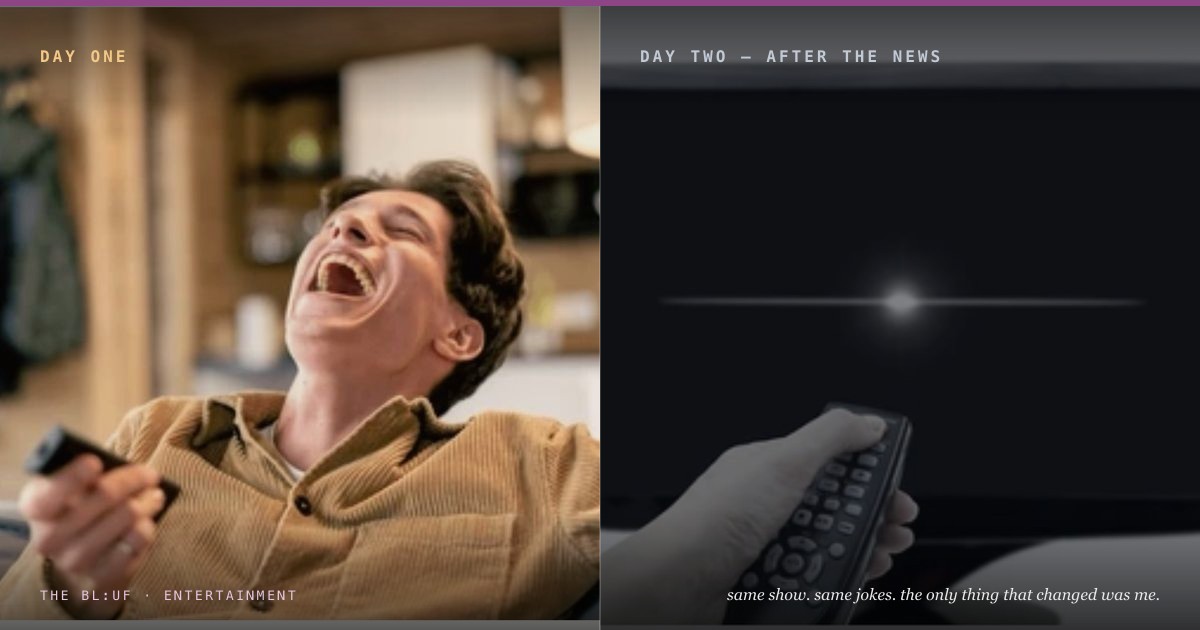
Let me tell you how much I love Frasier. I watch it daily — there's a whole channel dedicated to it now, finally rescued from sharing real estate with Cheers — and one afternoon I was watching an episode I had seen many times before. The one where Kim Coles guest-stars as the fill-in who quietly takes over the whole show. I knew the joke was coming. I laughed anyway — threw my head back so hard and so fast that I passed out, slid off my stool, and hit the floor, missing the corner of a table by inches.
I am telling you this so you understand the size of what came next.
A few days later, the news told me the man who plays Frasier Crane is a vocal supporter of Donald Trump. It landed like a gut punch. Smart, witty, erudite, impossibly funny Frasier — the character I'd organized my evenings around — was, off-screen, someone whose politics I find hard to be in a room with.
I tried the mental aerobics everyone recommends. Separate the man from the character. It didn't take. For about two weeks I sat through scenes that used to make me howl with a face like I was at a funeral. Then — and I can't tell you exactly when — the laughter came back. The show is on as I write this. I'm fine.
But it left me with the actual subject of this piece, which is not Kelsey Grammer.
It's the trick your brain plays on you. You spend years with a character — in your living room, at your lowest, on the nights you couldn't sleep — and your mind quietly files that intimacy under I know this person. You don't. A character is a script and a performance. The human who delivers it is a stranger you have never met. When the stranger turns out to hold views you find ugly, the spell breaks, and the loss feels enormous because the relationship felt real. Psychologists have a word for that one-way bond — parasocial — and the grief when it snaps is not silly. It's the cost of having loved something.
Here's the fair part, the part the internet usually skips: plenty of people separate the art from the artist cleanly, and they're not wrong to. The work exists on its own — the writers, the timing, the ensemble, the decades of craft don't evaporate because the lead votes in a way you don't. I'm not telling you to stop watching. I couldn't even make myself stop for more than a fortnight. And Grammer is allowed his politics; this isn't a referendum on him.
It's about where your line is — and there is a line, a long one.
Different politics is the mild end. A disagreement, even a sharp one, is not a crime. The far end is something else entirely. Bill Cosby was America's Dad — and then he was convicted, in 2018, of aggravated indecent assault. (Pennsylvania's Supreme Court threw out that conviction in 2021 over a due-process violation and he walked free — released on the process, not exonerated.) That wound doesn't heal, and it shouldn't, because it's not a matter of taste.
Most "the artist is not who I thought" moments land somewhere on that line between votes differently than me and did something monstrous. And the mild end is the one worth sitting with, because it asks the uncomfortable question: if a man's ballot can sour a show I genuinely love, how much of my joy was the show — and how much was a story I'd told myself about who he must be to be that funny?
One last thing, because the universe apparently has a sense of timing. The laughter came back a while ago — I'm back to watching daily — and as I write this, the channel served up Season 2, The Candidate: the episode where Frasier and his brother Niles are appalled by the politics of the candidate their father is backing. Their dad's the conservative; the brothers can't stomach the right-winger he's stumping for. So here I am, long past the grief, watching Frasier himself be disgusted by a conservative — while the man who plays him is one. On that one, the character is the opposite of the man. I genuinely don't know whether that makes it better or worse. It just makes it perfect.
The art never changed. Every joke is exactly as good as it was the day I fell off the stool. What changed was me — and what I briefly let a stranger's real self do to a made-up man I adored. The laughter came back the moment I stopped asking Frasier to be a good person and let him go back to being a character. Grammer can be a stranger I'm not obligated to invite anywhere.
Maybe that's the whole skill: loving the work without mistaking it for a window into a soul. You can keep the laugh. You just have to stop pretending it was ever proof of who he is.