The verdict came in fast and unanimous: Lizzo's new album flopped. The numbers are real — it missed the Billboard 200 entirely, the first time that's happened to her in years, and not one single charted. From there, everyone drew the same straight line: it failed because the songs aren't good.
Here's the question almost nobody asked: is that even how hits work?
A few years ago it was wall-to-wall Lizzo. "Truth Hurts" sat at No. 1 for seven weeks. "About Damn Time" won Record of the Year at the 2023 Grammys. Something shifted — that part's true. But "the songs got worse" is an assumption wearing the costume of a fact. And you don't flop after five albums. You stumble. The tell isn't that people criticized her — it's that a whole internet reached the same conclusion at once, and nobody stood on the other side of it to ask why.
The machine that makes you like a song
Think of a song you didn't like at first and now love. Odds are you didn't change your mind — you just heard it forty times. Psychologists call it the mere-exposure effect, one of the most replicated findings in the field: repetition breeds familiarity, familiarity breeds liking. It's not infinite — overplay a song and it curdles — but within that band, plays don't just measure how much you like a song. They manufacture it.
The industry has known this for seventy years, and we know they know, because they keep getting caught paying for it. That's what payola is. In 2005–06, New York's attorney general pulled settlements from all four major labels for buying airplay — Sony BMG $10 million, Universal $12 million, Warner $5 million, EMI $3.75 million. Labels don't spend that to reflect hits that already exist. They spend it because rotation is the furnace that forges one.
The test that never ran
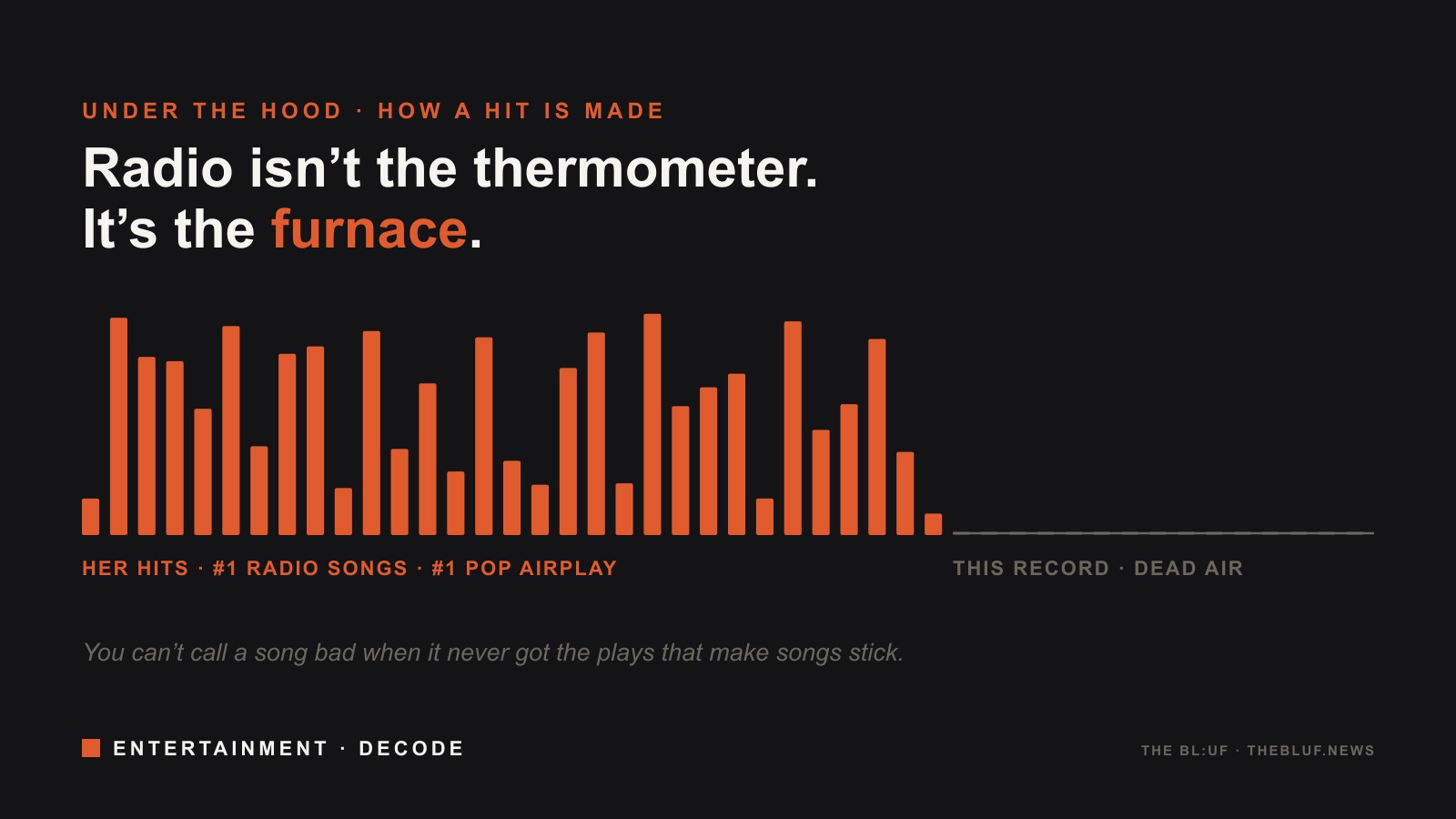
Her hits didn't just chart — they went to No. 1 on Radio Songs and Pop Airplay — the closest public read we get on how hard a label is working a record, because radio rotation is something labels actively push, not something that happens on its own. The new single? Effectively zero U.S. radio. Not "underperformed." Never showed up.
Sit with that. The song being called bad never got the one thing that makes songs feel good to us. So "it flopped because it's bad" makes a claim about quality using evidence that only measures reach. The plays that would have told you whether it sticks never happened.
The honest other side
Rotation isn't destiny. Some songs claw up with no help — a hook good enough to survive a TikTok and nothing else. In the largest study ever run on this, researchers built a fake music market with 14,000 people and found quality sets the floor and ceiling — the best songs rarely did poorly, and the worst rarely did well — but within that band, any other result was possible. So this isn't "Lizzo was robbed." Maybe the record really is a step down. The point is narrower: exposure is a massive, ignored variable, and the pile-on is treating a race nobody let her run as proof she can't run.
Why the machine went quiet
There's an obvious candidate for what shifted. In 2023, former dancers sued Lizzo, alleging sexual harassment and a hostile workplace. As of mid-2026 the case is still active in Los Angeles Superior Court: a judge threw out the widely-repeated fat-shaming claim in December 2025, but let the bulk of the suit — harassment, false imprisonment, and more — proceed. Lizzo has publicly refused to settle, saying she is "not afraid of the truth." The allegations are unproven. But the controversy plainly dented her public standing — Lizzo herself points to "the very obvious and public attack on my career" — and that's the confounder: a label going quiet and the world going quiet on a litigated star produce the exact same silence at radio. The one number that would tell them apart — what her label actually spent — is the one nobody outside the building can see.
So the flop is over-determined: bad timing, a damaged brand, maybe a weaker record, and a promotional machine that, for reasons we can measure the effect of but not the intent behind, simply didn't run.
The bottom line
We're not telling you the album is good — we haven't heard it enough to know, and now you understand why that sentence is doing more work than it looks like. We're telling you the confident part of the consensus, the "it's bad" part, rests on the one thing the evidence can't support. Everyone answered "is it a flop?" Nobody checked whether "flop means bad" was ever true. Under the hood, it isn't — not for a song the machine left in the dark.