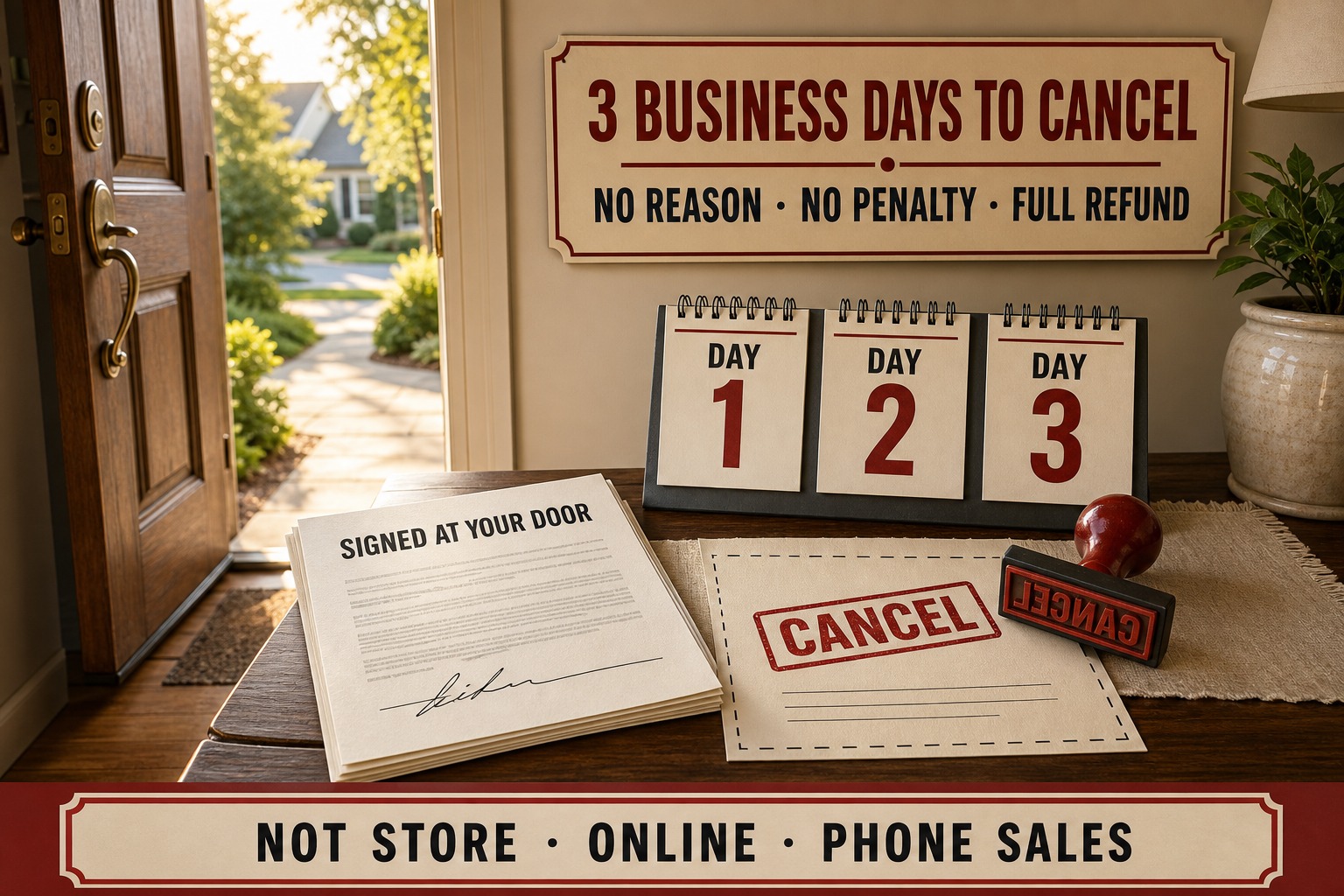
Here's the part of the pitch the salesperson at your kitchen table has no reason to mention: if you sign tonight, federal law gives you until midnight three business days from now to tear the whole thing up — no reason required, no penalty, every dollar back.
Journalism, not legal advice. This explains how a right works in general terms. Whether a particular sale is covered turns on where and how you bought — if you're unsure, your state consumer-protection office or attorney general can tell you before the clock runs out.
The lever. When a seller closes a deal somewhere that isn't their own store — your living room, your workplace, a dorm, or a space they rented for the day like a hotel meeting room, a convention center, or a booth at the fairgrounds — you get a cooling-off period. Three business days to cancel, in writing, for any reason or none. The seller then has to give back everything you paid, return any trade-in, and unwind any financing. It's the escape hatch for the high-pressure, sign-now-or-lose-the-deal sale: the vacuum demo, the roof or window pitch, the water-filter rep, the "today only" ballroom seminar.
The receipt. This is the FTC's Cooling-Off Rule, on the books since the 1970s and written down at 16 C.F.R. Part 429. The rule covers sales of $25 or more made at your home, and $130 or more made at a temporary location away from the seller's permanent place of business. The buyer's copy of the contract has to carry the exact line: you "may cancel this transaction at any time prior to midnight of the third business day after the date of this transaction." Saturday counts as one of those three days; Sundays and federal holidays don't. And the seller can't stay quiet about it — the rule requires them to tell you about the right out loud and hand you two copies of a dated cancellation form, plus a copy of your contract or receipt, at the moment of sale.
The catch — and the scam version. The rule is narrower than people think, and that cuts both ways.
First, the real limits. It only reaches sales made in person, away from the seller's fixed store. It does not cover anything you buy at a shop, online, by mail, or over the phone; it doesn't cover real estate, insurance, securities, or repairs you called and asked for yourself. Cars are a trap worth reading twice: the rule exempts vehicles sold at auctions, tent sales and other temporary lots by a dealer who keeps a permanent place of business (16 C.F.R. § 429.3(a)) — but that exemption is about where the sale happened, not the fact that it's a car. A dealer who closes the deal in your living room is a different situation, and you shouldn't assume you're out of luck. Buy a couch at the furniture store and change your mind, and this rule does nothing — that's up to the store's return policy.
Now the scam version, which comes in two flavors. One: the seller who says "all sales are final" or simply never hands you the cancellation forms. Skipping that form is itself a violation of the rule — and a loud signal you're dealing with someone who's counting on you not knowing your rights. Two: the myth, sometimes pushed by hustlers and sometimes just repeated by well-meaning people, that you can cancel any purchase within three days. You can't. There is no general federal three-day right to undo a car purchase, a gym contract, or a store buy. A few specific things carry their own cooling-off windows under state law — timeshares, some health-club memberships, funeral goods — but those are separate rules with their own deadlines. Anyone who tells you "everything" has a three-day return window is selling you a comforting fiction.
The whole thing hinges on one habit: when someone sells you something expensive in your own home, don't throw away the paperwork. The cancellation form isn't a formality. It's a three-day key, and it's already in your hand.
✅ Do It Now
- Check the clock first. You have until midnight of the third business day after the sale. Saturday counts; Sundays and federal holidays don't. If you're near the edge, act today.
- Sign and date one copy of the cancellation form the seller gave you. If they never gave you one — a violation in its own right — write your own dated letter saying you're cancelling, and keep a copy.
- Mail it to the cancellation address on your contract. What matters is the postmark: as long as the envelope is postmarked before midnight of the third business day, you're on time, even if it lands on the seller's desk later. Send it certified so you have proof.
- Watch the refund window. The seller then has ten business days to refund your money and return any trade-in.
- If they stall or refuse, report it to the FTC at ReportFraud.ftc.gov and to your state attorney general's consumer-protection office. The FTC's plain-language walkthrough lives at consumer.ftc.gov.