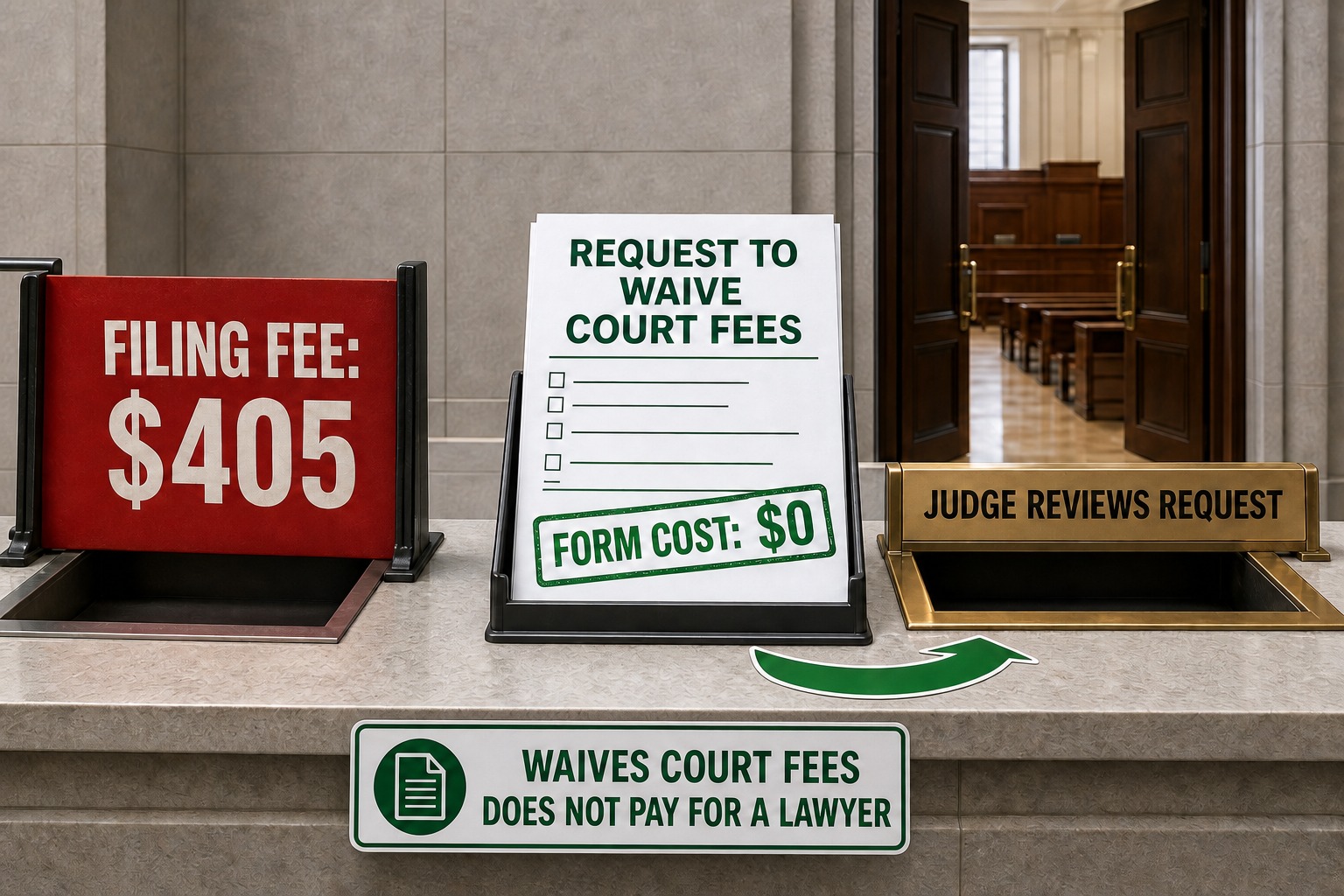
Here's something the clerk's window won't mention while you're counting out the filing fee: if you genuinely can't afford it, you may not have to pay it at all. Not a payment plan. A waiver — and the idea has been part of the courts, in one form or another, for centuries.
Journalism, not legal advice. This explains how a right works in general terms — whether you qualify, exactly what's covered, and which form to file depend on your court and your state. Court self-help centers and legal-aid offices walk people through this for free; that's the place to start.
The lever. Courts charge money just to let you through the door. Filing a civil case in U.S. district court costs $405 — a $350 fee plus a $55 administrative charge — and state trial courts commonly charge anywhere from $50 to several hundred dollars to open a case or respond to one. If paying that would mean not covering rent or groceries, the law lets you ask the court to waive the fees entirely. In federal court the request is called proceeding in forma pauperis — Latin for “in the manner of a poor person” — and by statute it reaches any suit, action, or proceeding, civil or criminal, or appeal. In state court it's usually a single form filed with your first papers. Qualify, and the fees standing between you and the courthouse simply come off.
The receipt. In federal court the authority is 28 U.S.C. § 1915, which lets a court authorize a case “without prepayment of fees” for a person who files an affidavit stating they are unable to pay. You don't have to guess at the wording — the courts publish the exact forms: AO 240 (a short application) and AO 239 (a longer financial statement), both free to download at uscourts.gov. States run their own version. California's, for example, is Form FW-001, “Request to Waive Court Fees,” and its rules spell out three ways to qualify — you need to meet only one: you receive a listed public benefit (Medi-Cal, CalFresh, SSI, CalWORKs, General Assistance and others), your household income is at or below the limit printed on the form, or you can show you can't afford your household's basic needs and the fees at the same time.
Who it's really for — and the catch. A waiver covers court fees — filing your papers, having the sheriff serve them, certified copies, a court reporter's attendance at trial — not the cost of a lawyer, and not fines or private mediation. There are real limits. In federal court, § 1915 also lets a judge dismiss the case “at any time” if it is “frivolous or malicious,” “fails to state a claim,” or targets a defendant who is legally immune — so a waiver gets you in the door, it doesn't shield a weak case. And the money isn't always gone for good — though the payback rules are narrower than they sound, and the difference matters. In California, if you settle or win a civil case for $10,000 or more, the waived fees become a lien the court collects out of your recovery before the case can close (Cal. Gov. Code § 68637(c)) — that one applies to civil cases generally. Only in family law cases does a court entering judgment have to reconsider whether your circumstances changed enough to make you repay some or all of it (§ 68637(e)). Outside family court, California has no general "your finances improved, now pay it back" rule. The waiver is a bridge over the fee, not a gift you never account for — but check your own state, because this is exactly the kind of detail that varies.
The scam version — because there's always one. These forms are free, from the court's own website and its self-help center. So anyone who charges you a fee to “get your court fees waived,” or guarantees a judge will approve it, is selling you something you can get for nothing. The Federal Trade Commission has warned for years about operators — sometimes calling themselves a “notario,” “notary,” or “consultant” — who charge for free government forms and do legal work they aren't authorized to do, botching paperwork and putting people's cases at risk. Real help with these forms comes free from the court's self-help center or a legal-aid office; it doesn't come from someone cold-calling with a fee.
The door to the courthouse was never supposed to carry a price tag for people who can't pay it. The form that proves it is one page, and it's free.
✅ Do It Now
- Find your form. Federal case: AO 240 (short) or AO 239 (long) at uscourts.gov/forms-rules/forms. State case: search your state courts' site for “fee waiver” — in California it's Form FW-001 at courts.ca.gov.
- Check whether you qualify. Getting a listed public benefit is usually the fastest path; if not, low income or “can't afford basics and fees” can also qualify you. You only need to meet one.
- File it with the court — for free. Turn it in with your first papers (or as soon as you can) at the clerk's window or through the court's e-filing. Never pay anyone to “process” or “guarantee” it.
- Get free help if you're stuck. Your court's self-help center and local legal aid (find one at lawhelp.org) walk people through fee waivers at no cost — that's who to trust, not a paid “consultant.”
Journalism, not legal advice. Amounts, qualifying limits, what's covered, and repayment rules vary by court and state — confirm with your court's self-help center or a legal-aid office before you file.