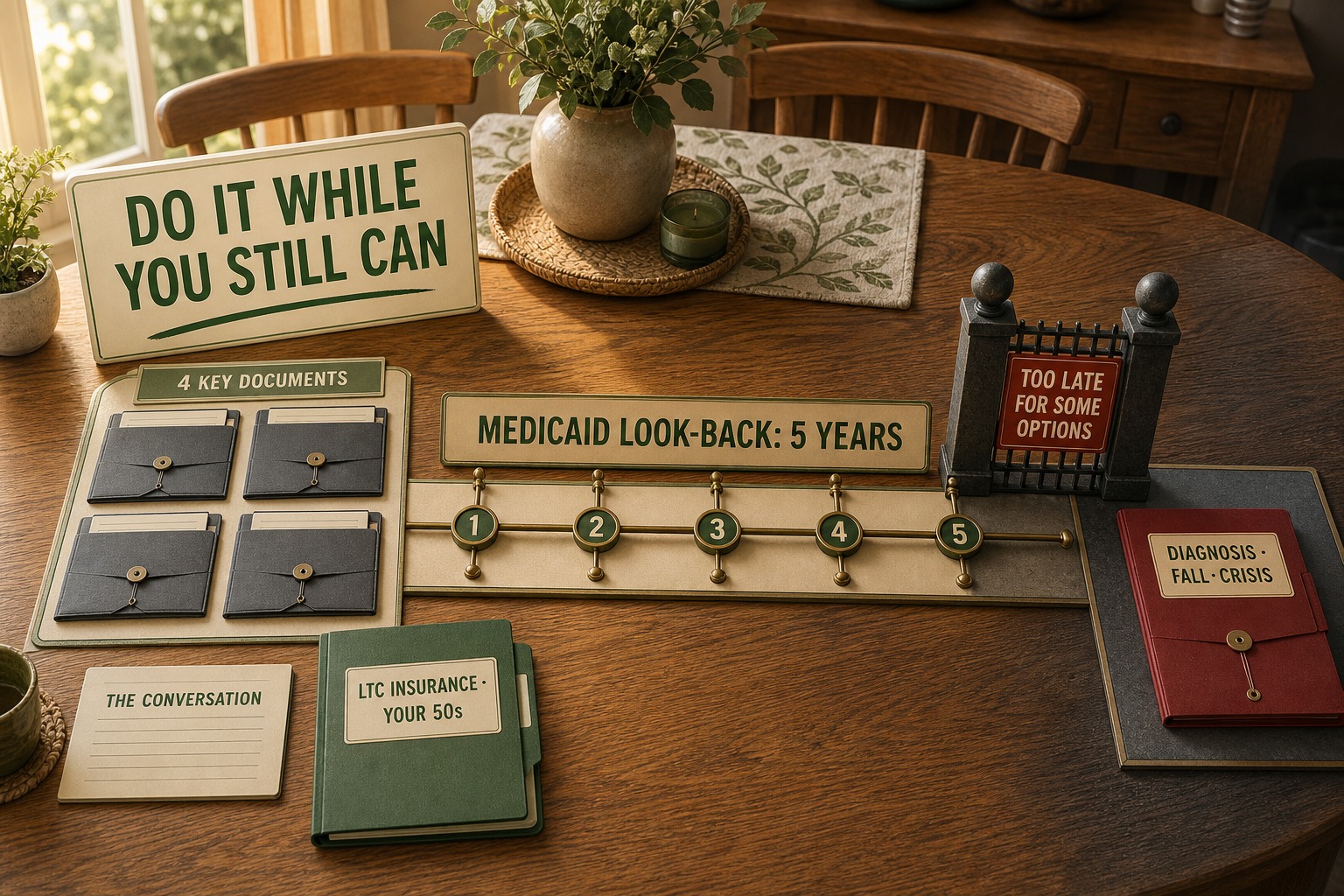
Every hard story in this series shares one feature: by the time the family was living it, the best options were already gone. The good move in elder care is almost never available in the moment you need it — it was available three or five years earlier, to a version of you who didn't think they needed it yet. That's not bad luck. It's the structure. Which means the single most useful thing this series can leave you with is a list of things to do while nothing is wrong.
Here it is. Most of it is free or cheap. All of it gets harder, or impossible, once a crisis or a diagnosis arrives.
1. The four documents — before anyone needs them
These cost little and are useless if you wait until someone can't sign them. Get them done while everyone is healthy and competent:
- Durable financial power of attorney — lets someone manage money and bills if a parent can't. Without it, families end up in court (guardianship) to do basic things.
- Healthcare power of attorney (health-care proxy) — names who makes medical decisions.
- Advance directive / living will — what care someone does and doesn't want at the end.
- HIPAA release — without it, providers can legally refuse to even talk to you.
A will handles what's left; these four handle the years before. The first time you discover you don't have them is always the worst possible time.
2. Understand the look-back clock — and start it early
Part 3's five-year Medicaid look-back is the reason planning is a years-ahead activity. Any asset protection — trusts, transfers, retitling a home — generally needs to happen more than five years before care is needed to fully clear that window. You can't decide to protect the house the month Mom needs a nursing home. An elder-law attorney (naela.org) is worth one paid consult in your 50s–60s, not your 80s.
3. Long-term-care insurance — if it makes sense, the time is your 50s
Traditional LTC insurance gets dramatically more expensive (and harder to qualify for) with each year and any health change. Bought around age 55, a no-inflation policy often runs roughly $950–$1,500 a year for an individual and about $2,100 for a couple; adding an inflation rider costs more. It isn't right for everyone — for some, self-funding or a hybrid life/LTC policy fits better — but the decision has a clock on it. By the time you're sure you'll need it, you usually can't get it affordably.
4. Have the conversation — and write down where everything is
The most valuable document of all is the one nobody makes: a single page of where things are. Accounts and institutions, the insurance policies, the attorney, the documents above and their location, online logins, who to call. Have the awkward conversation now — what a parent wants, what they have, who they trust to act. Families that talk early make decisions out of love; families that wait make them in crisis, exhausted and guessing.
The bottom line
You can't control whether you'll need care. You can almost entirely control whether your family hits the wall the rest of this series describes — and the difference is a handful of hours, spent years before it matters, on documents and one honest conversation. That's the whole secret. The people who get through this best aren't luckier. They started before they had to.
✅ Do It Now (the whole-series checklist)
- Four documents: durable financial POA · healthcare POA · advance directive · HIPAA release. (Many states have free fill-in forms; an estate or elder-law attorney does all four affordably.)
- One paid elder-law consult in your 50s–60s — naela.org. Ask about the 5-year look-back for your state.
- Price LTC insurance / hybrid options now if you're in your 50s — and decide on purpose, not by default.
- Make the "where everything is" page and have the conversation this month.
- Free help any time: SHIP (shiphelp.org · 1-877-839-2675) · Area Agency on Aging (eldercare.acl.gov · 1-800-677-1116).
Journalism, not financial or legal advice — including any insurance product decision. Confirm specifics with a SHIP counselor, a fee-only financial advisor, or an elder-law attorney.