The microphone: ShotSpotter
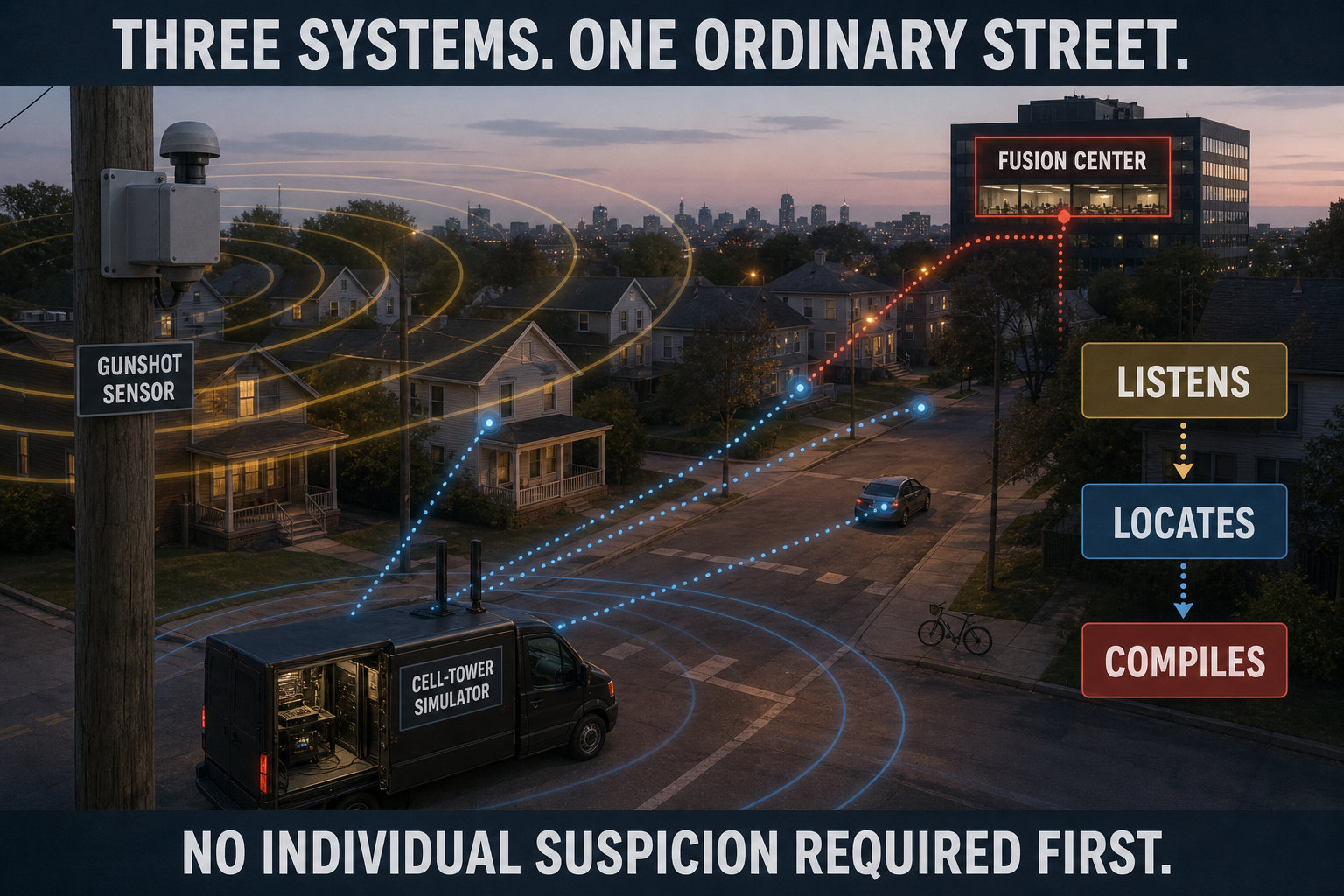
Rooftop and pole-mounted microphones, branded ShotSpotter and now sold by a company called SoundThinking, try to triangulate the location of a suspected gunshot and alert police within about a minute. As of SoundThinking's own 2025 SEC filing, the system covers over 1,000 square miles across 178 cities.
Three separate, independent reviews — not one advocacy group's opinion repeated three times, but three different institutions — found the same thing. Two of the three looked at the same city from different angles: the MacArthur Justice Center's review of Chicago data found 89 percent of alerts turned up no evidence of a gun crime, and Chicago's own Office of Inspector General, reviewing a different, overlapping slice of that city's data, found alerts led to a written incident report just 2 percent of the time. New York City's Comptroller, reviewing NYPD's separate use of the system, found 87 percent of alerts sent officers to a location with no confirmed shooting. Two cities, three reviewers, the same order of magnitude.
It has also produced at least one documented wrongful-arrest case with a real financial outcome. Chicago settled with Michael Williams for $500,000 in March 2026, after he spent nearly a year in jail on a murder charge built on a theory that ShotSpotter's own contract says the system isn't built to support: that the gunshot it detected had been fired from inside his moving car. The system had correctly located a gunshot; what it couldn't do, and what prosecutors used it for anyway, was determine where inside a vehicle that shot came from. Separately, in Rochester, New York, Silvon Simmons was acquitted of attempted murder by a jury in 2017 but convicted, in the same trial, of a weapons charge; a judge ruled in January 2018 that the ShotSpotter evidence used against him was unreliable and vacated that conviction, which prosecutors then dropped. Analyst reclassification of a detected sound at police request isn't unique to either case — a ShotSpotter expert testified under oath in a separate Chicago case that it happens "on a semi-regular basis with all of our customers."
SoundThinking disputes the independent reviews, citing a company-commissioned audit claiming 97 percent accuracy and arguing the critics conflate "no evidence recovered" with "no gunfire occurred" — a real methodological distinction worth including for fairness, even though it doesn't address the wrongful-arrest cases or the reclassification testimony. Chicago has now gone roughly two years without any gunshot-detection system, still hasn't picked a replacement, and SoundThinking itself is one of the bidders.
The fake tower: cell-site simulators
Commonly called Stingrays, these devices impersonate a cell tower so nearby phones connect to them instead of a real one — revealing a phone's location, sometimes to a specific room, and sweeping up data from every other phone in range at the same time, not just a target's.
For years, agencies using them signed non-disclosure agreements with the FBI requiring them to hide the fact they'd used one — including, in documented cases, from the judge signing the surveillance order. Tacoma, Washington paid $182,340 in court penalties for withholding public records about its own Stingray use. Baltimore prosecutors withdrew evidence in at least one case rather than reveal the technology in court.
The old brand-name hardware is genuinely fading — L3Harris, maker of the original Stingray, stopped selling to local police around 2020. But that's not the same as the capability shrinking. Newer, harder-to-detect systems from a company called Jacobs Technology are now the leading replacement, and ICE signed new cell-site simulator contracts in both 2024 and 2025 — federal spending on this technology is growing. A federal magistrate in Akron, Ohio rejected a request in July 2026 to run a cell-site simulator continuously across a wide area for 30 straight days, comparing it to searching an entire city block without individualized suspicion — a live example of courts starting to push back on the broadest requests, even as use overall expands.
The hub: fusion centers
After 9/11, the federal government funded roughly 80 state and regional "fusion centers" — joint federal-state-local intelligence hubs meant to catch terrorist plots by pooling data: license-plate hits, social media monitoring, tips, and criminal records.
A two-year, bipartisan U.S. Senate investigation, completed in 2012, reviewed 13 months of fusion-center reporting and found not one of them ever identified a terrorist threat or helped disrupt a plot. Most of what they produced concerned routine drug and cash-smuggling arrests, not terrorism — while the Department of Homeland Security had spent somewhere between $289 million and $1.4 billion on the centers without adequately tracking the money. The Senate's own words: reporting was "oftentimes shoddy, rarely timely, sometimes endangering citizens' civil liberties."
That pattern isn't a 2012 relic. A leaked December 2025 bulletin from a fusion center in the Philadelphia area — reported in 2026 — flagged "disruptive First Amendment activity" opposing AI data centers as a domestic-violent-extremism risk indicator, citing evidence that included a Dune movie meme about sabotaging data-center infrastructure and complaints about rising utility bills. A civil rights attorney's response to the bulletin: it treats constitutionally protected dissent as suspicious.
What this piece is not saying
This isn't saying gunshot-detection technology, cell-site simulators, or intelligence-sharing hubs are illegal — none of them are, and each has a stated public-safety purpose that isn't fabricated. It isn't saying every officer or analyst using these systems acts in bad faith; the documented failures here are about accuracy, oversight, and secrecy, not necessarily intent. And it isn't claiming the Philadelphia bulletin represents every fusion center's current practice — it's one documented, recent case that matches a well-established historical pattern, not proof every center is doing the same thing today.
What can I do
Be honest about the limits here before anything else: none of these three systems put the off-switch in an individual's hands. You cannot personally disable a microphone on a public street, detect a cell-site simulator without specialized equipment, or find out what a fusion center holds on you.
What's real: a blunt, imperfect warning sign for a cell-site simulator is your phone unexpectedly dropping to an older, less-secure network — turning off 2G where your phone allows it (a real setting on Android 12 and later) closes off the easiest version of the attack. iPhone has no dedicated toggle for this, though Apple's Lockdown Mode does block the specific 2G-downgrade connection method these devices rely on, as one piece of a much broader security lockdown. Using Signal or another end-to-end encrypted app protects what you actually say even if the connection itself gets intercepted.
Beyond that, the lever is civic, not personal — though it doesn't always run through the body you'd expect. Chicago's ShotSpotter contract actually ended by mayoral decision in 2024, not a council vote: the City Council voted 33-14 to try to keep the contract, and the mayor cancelled it anyway using his own authority, over their objection. What's consistent across every case in this piece isn't which part of local government acts — it's that some form of government action, not an individual's own choice, is what's ended these programs so far. Public-records requests and leaked documents — the Philadelphia bulletin above surfaced through a leak, not a records request — are, so far, the only way anyone outside a fusion center has learned what one is actually doing.
Why this is a BL:UF story
Three different systems, three different vendors, one shared design: each one operates on you without requiring you to have done anything. A gunshot mic listens to your whole block. A cell-site simulator sweeps up every phone in range, not just a suspect's. A fusion center's "intelligence" file can be built from things you posted publicly and never intended as a threat to anyone. The Senate already investigated one of these and found it doesn't work. It's still running.
The Receipts
- MacArthur Justice Center: "ShotSpotter Generated Over 40,000 Dead-End Police Deployments in Chicago in 21 Months"
- Chicago Office of Inspector General: "Chicago Police Department's Use of ShotSpotter Technology," August 2021
- NYC Comptroller: audit of NYPD ShotSpotter use, June 20, 2024
- WTTW: Michael Williams $500,000 settlement, March 4, 2026
- NY Daily Record: Silvon Simmons trial and the January 2018 ruling on ShotSpotter evidence reliability
- ABA Journal: ShotSpotter analyst reclassification testimony, including the "semi-regular basis" quote from a separate Chicago case
- ACLU: "Surreal Stingray Secrecy: Uncovering the FBI's Surveillance Tech Secrecy Agreements," December 15, 2021 — Tacoma's $182,340 records-withholding penalty and the Baltimore prosecutors-withdrew-evidence account
- Techdirt: federal magistrate rejects 30-day cell-site simulator warrant, Akron OH, July 2026
- U.S. Senate Homeland Security and Governmental Affairs Committee: bipartisan investigative report on fusion centers, 2012
- The Intercept: Philadelphia-area fusion center bulletin on AI data-center protests, 2026
Full sourcing detail, including single-sourced flags on the SoundThinking rebuttal figures and the multi-city Stingray-agency cancellation list, is in newsroom/research-surveillance-sweep-2026-08-24.md.